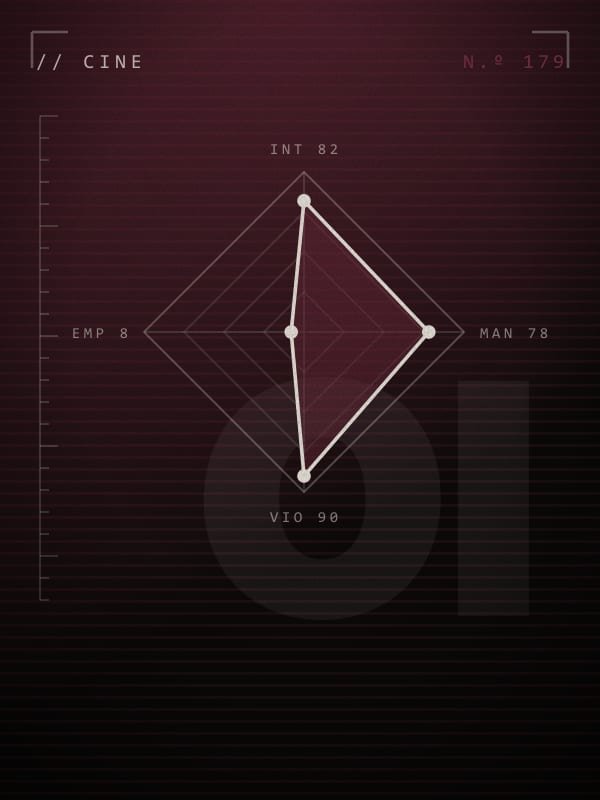
Ghostface, the masked killer of the Scream saga (1996), does something that sets off every alarm of deterrence: he phones his victims before killing them. He jokes, plays, quizzes them about horror movies, threatens them —he exposes himself, drags out the attack, risks being located—. Why run such an absurd risk? Because behind the white mask and the black robe, Ghostface feels invisible: anonymous, untraceable, impossible to identify. The mask is not just a disguise; it is the source of a subjective certainty of impunity. For the theory of deterrence, Ghostface illustrates how anonymity disables the brake of punishment: when the criminal believes no one can put a face to him, his perceived risk of capture sinks to zero.
// The theoryThe mask and perceived certainty
The key to deterrence, as Daniel Nagin has measured it, is that it does not depend on the real certainty of capture, but on the perceived one. An offender is curbed if he believes he will be caught, even if objectively the risk is low; and he is not curbed if he believes he will escape, even if objectively the risk is high. Ghostface lives in the second case. The mask gives him a perception of anonymity so powerful that it annihilates his sense of risk: anyone could be underneath, no one knows who he is, the identity is interchangeable —in fact, across the saga there are different killers under the same mask—. That anonymity is what lets him play with his victims, call them, expose himself: he believes himself beyond the reach of any consequence. The theory stresses this mechanism because it is real and contemporary: anonymity —of the mask, of the crowd, of the internet— reduces the perceived certainty of capture and, with it, the deterrent power of punishment. Many crimes that no one would commit with an uncovered face are committed under the shelter of anonymity, not because the punishment is lesser, but because the criminal believes his name will never be attached to it.
Anonymity as the solvent of deterrence
Ghostface illustrates that anonymity is one of the great enemies of deterrence. The certainty of capture has two components: that you are detected committing the crime and that you are identified as its author. Anonymity attacks the second. A thief can be recorded by a camera, but if he is masked and no one can recognize him, the certainty of identification —and therefore of punishment— collapses. Ghostface takes it to the extreme: the mask is so generic that the killer could be anyone, and that interchangeability is his shield. Deterrence theory draws from this a powerful practical lesson: much of modern situational prevention consists precisely of attacking anonymity —identification at entry points, license-plate registration, digital traceability, cameras that recognize faces—. Not to punish more harshly, but to raise the certainty that, if you offend, it will be known who you were. Against a Ghostface, deterrence is not reinforced with harsher penalties, but by tearing off the mask: taking away the perception that he can act without a face.
Get the map of theories for free
Subscribe to the criminal archive —one case a week, no spam— and I'll send you The map of theories: the great currents of criminology on a single sheet.
// The subjectThe interchangeable killer
What is characteristic of Ghostface, and what sets him apart from other horror icons, is that there is not a single Ghostface. Across the saga, different people —neighbors, friends, relatives of the victims— put on the same mask. Ghostface is not a supernatural monster with a fixed identity, but a role anyone can assume. That trait is criminologically revealing: it underscores that what kills is not a special being, but the position of believing oneself anonymous and immune. Any ordinary person, shielded by the mask and convinced they will not be caught, can become a killer. It is an unsettling and at the same time lucid idea: Ghostface's evil does not reside in a monstrous nature, but in the combination of a motive (revenge, jealousy, notoriety) with the perception of impunity that anonymity grants. Killers are fully responsible for their acts —the mask excuses nothing—, but the saga shows that the barrier deterrence was meant to raise crumbles the moment someone believes themselves invisible.
Ghostface
// The crackNeither blame the mask alone, nor ignore its power
The crack with Ghostface is to attribute the crime exclusively to anonymity —"the mask did it"— and lose sight of the fact that behind every Ghostface there is a person with a motive, a decision and full responsibility. Anonymity does not create the killer; it removes the barrier that held him back. Whoever kills under the mask already wanted or was willing to kill; the mask only gave him the perception of impunity that disinhibited him. To reduce the problem to the mask would be to excuse the killer, and that is something deterrence does not permit: the one responsible is always the subject. The opposite crack is to minimize the power of anonymity, to treat it as a detail. That would be a mistake: the evidence —from the classic experiments on deindividuation to behavior on the internet— confirms that anonymity disinhibits conduct that identification would curb. It is a real and potent factor, though never an excuse.
The honest reading holds both things: the killer is responsible, and anonymity is a multiplier that society would do well not to hand out for free. That the saga insists on unmasking Ghostface at the end of each installment —revealing the human face beneath the mask— is its way of saying what deterrence affirms: that there is no real impunity, that every mask eventually falls, and that the best prevention is making sure no one can truly believe they will act without a face and without consequences.
Three key ideas
- Ghostface, the killer of Scream, calls his victims before killing because the mask gives him a subjective certainty of impunity: he believes himself anonymous, untraceable, untouchable.
- Deterrence depends on the PERCEIVED certainty of capture, not the real one. Anonymity attacks the identification of the author and collapses that perception: many crimes are committed masked not because the punishment is lesser, but because the criminal believes his name will not be attached to it.
- Neither blame the mask alone (the killer is fully responsible; anonymity removes the barrier, it does not create the motive) nor ignore its disinhibiting power. Against Ghostface, deterrence is not reinforced with harsher penalties, but by tearing off his anonymity.
Sources · further reading
- Bonn, S. (2014). Why We Love Serial Killers. Skyhorse Publishing.
- Nagin, D. S. (2013). Deterrence in the Twenty-First Century. University of Chicago Press.
- Zimbardo, P. (2007). The Lucifer Effect. Random House.
Case-file questionsFrequently asked questions
¿Quién es Ghostface?
Ghostface («La Máscara») es un villano de Scream, analizado en KRIMINIS con la lente de la criminología. He phones the victim before attacking.
¿Por qué Ghostface (La Máscara) se convierte en villano?
Ghostface and deterrence: the mask as a guarantee of impunity. The anonymity that makes the killer believe he is untouchable, and that is why he phones his victims.
¿Qué teoría criminológica explica a Ghostface?
El caso de Ghostface se analiza desde la Teoría de la Disuasión. Deterrence (Beccaria, Nagin) curbs crime if the criminal believes he is likely to be caught. Ghostface, the masked killer of Scream, feels immune because the anonymity of the mask gives him a subjective certainty of impunity: that is why he calls his victims before killing them. The mask drops his perceived risk of capture to zero —and deterrence rests on that perception, not on reality—.