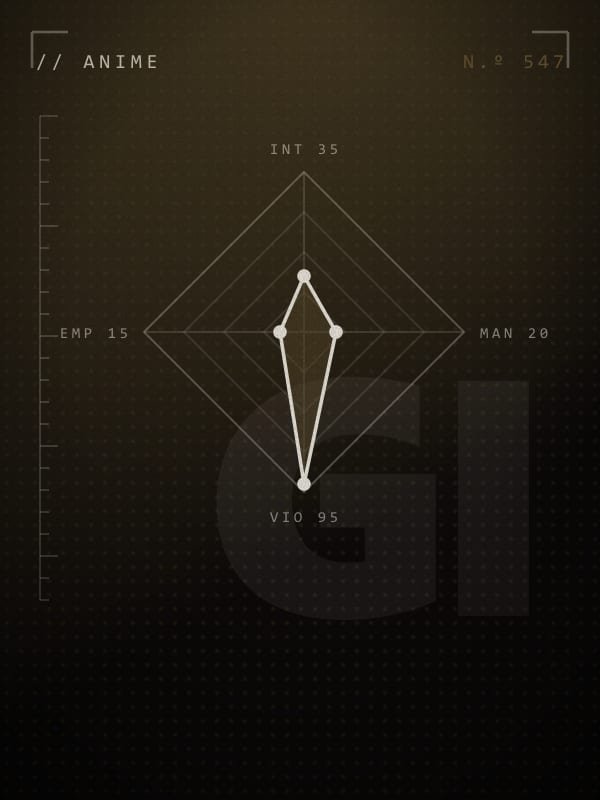
A disfigured boy whom the other children at camp mocked. The counselors, distracted, failed to watch him, and Jason Voorhees drowned in the lake at Crystal Lake while no one was looking. Decades later, something came back from that lake: a silent bulk behind a hockey mask that punishes, without rest, the young people who occupy the camp where no one cared for him. Jason barely exists as a person (he is almost pure force), but at the origin of the unstoppable bulk there is a very concrete wound: a boy marked by his face, excluded because of it, and abandoned to die.
// The theoryThe bulk that was once a marked boy
Before the horror icon, there was a boy who fits squarely into Goffman's stigma of the body: a visible deformity that reduced him, in the eyes of others, to a single trait. The other children did not see a companion; they saw a face to laugh at. That is the first violence in Jason's story, and it is Goffman's: the virtual social identity—the little monster—erases the person before he can be anyone else. The mark pushes him to the margin of the group; and being at the margin, with no one who truly looks at him, is what leaves him alone and unattended by the water.
That Jason wears a mask is not a wardrobe detail: it is the theory made image. Goffman called the life of the stigmatized a management of spoiled identity (the effort to control how the mark is shown), and Jason takes it to the literal extreme: he covers forever the face the world could not bear to look at. Behind the mask there is almost no person left, only a function: to punish. His victims are echoes of those who abandoned him (carefree teenagers, counselors who prefer sex to vigilance), and his revenge eternally repeats the original scene. The monster is the mark made flesh, returned with interest to the world that pointed at it.
The mask that covers the mark
Jason's hockey mask is one of the most effective symbols of stigma in all of pop culture. It covers the face—the mark—and, in doing so, erases the last thing that remained human: without a face, Jason stops being someone and becomes something. It is the final destiny of the spoiled identity Goffman described: when the world reduces a person to their mark for long enough, it can end up reducing them entirely—neither the person nor the mark is left, only the functional monster into which both resolved. Jason does not speak because there is no longer anyone in there to listen to. The face no one wanted to look at ended up vanishing behind a mask, and with it the boy he once was.
// The subjectThe guardian who did not look
The true original sin of Friday the 13th is not a deformity: it is negligence. What kills Jason is that the adults in charge of caring for him looked the other way—literally, the counselors were distracted when the boy drowned. Here the theory of stigma crosses with that of routine activities: harm occurs when a capable guardian is absent, and here the guardian was absent twice over—no one protected the marked boy from the mockery, and no one watched him in the water. The entire saga is the bill for that abandonment, collected again and again from the successors of those who did not care. And his mother, Pamela, is the first link: a woman broken by grief who begins the killing in the name of the son the world let die. Behind the unstoppable icon there is, at bottom, a very small and very sad story: that of a boy no one was watching.
Jason Voorhees
Get the map of theories for free
Subscribe to the criminal archive —one case a week, no spam— and I'll send you The map of theories: the great currents of criminology on a single sheet.
// The crackBackstory or plot excuse?
We have to be honest: Jason is, above all, a killing machine of slasher cinema, and his tragic backstory was rewritten and contradicted across a dozen sequels—reading a coherent criminological thesis into him is, in part, generosity. The theory of stigma illuminates the origin of the myth, not a moral case: Jason murders innocents without nuance, and there is no reintegration policy for an unstoppable force. Moreover, the character himself embodies a stigma worth naming: horror's habit of making the deformed body the face of evil (Jason, Freddy, the Phantom), a prejudice as convenient as it is unjust toward those who live with real differences. The useful reading does not sanctify Jason; it uses his origin to point to two true things: that failing the vulnerable has consequences, and that coding difference as a threat is, in itself, a stigma.
Looking at the boy no one looks at
Stripped of the knife, Jason's case points to the most prosaic and the most important thing: caring for the vulnerable in time. The marked, excluded and neglected boy is not a horror script; he is a real risk profile — bullying over appearance, the isolation of the one who "is different," the absence of an adult to watch and protect—. Prevention is not in the mask or in the lake: it lies much earlier, in the camp yard where some children laugh at another and no adult intervenes. And there is a second, cultural task: to stop teaching, film after film, that the different face is the monster's. Truly looking at the boy no one looks at—that is the least spectacular and most necessary lesson left by the silent bulk of Crystal Lake.
Three key takeaways
- Jason embodies Goffman's stigma of the body: a disfigured boy reduced to his mark, mocked and excluded. His hockey mask is the "management of spoiled identity" in its most literal form—covering the face the world could not bear to look at.
- His origin crosses stigma with the failure of the guardian (routine activities): what kills Jason is the negligence of those who were supposed to care for him. The saga is the eternal bill for that abandonment.
- The crack: it is above all a slasher machine with a rewritten backstory, and it embodies a prejudice—deformity = evil—worth naming. Its real lesson: care for the vulnerable in time and stop coding difference as a threat.
Sources · further reading
- Goffman, E. (1963). Estigma: la identidad deteriorada. Prentice-Hall.
- Cohen, J. J. (1996). “Monster Culture (Seven Theses)”. En Monster Theory. University of Minnesota Press.
- Cohen, L. E. & Felson, M. (1979). “Social Change and Crime Rate Trends”. American Sociological Review, 44.
- Link, B. G. & Phelan, J. C. (2001). “Conceptualizing Stigma”. Annual Review of Sociology, 27.
Case-file questionsFrequently asked questions
Who is Jason Voorhees?
Jason Voorhees (“Jason”) is a villain from Friday the 13th, analysed on KRIMINIS through the lens of criminology. A disfigured boy whom the other children at camp mocked.
Why does Jason Voorhees become a villain?
Friday the 13th and the stigma of the body: Jason Voorhees was a disfigured boy the others mocked and whom the counselors let drown. The silent bulk behind the hockey mask began as a face the world could not bear to look at.
Which criminological theory explains Jason Voorhees?
Jason Voorhees's case is analysed through Stigma. Jason Voorhees illustrates Goffman's stigma of the body carried into the iconography of horror. The boy Jason once was ended up reduced to his disfigured face: mocked by his peers, excluded and, through the negligence of those who were supposed to watch him, drowned in the lake. The unstoppable bulk behind the hockey mask is born of that mark and that abandonment. His mask is, moreover, the most literal version of the "management of spoiled identity": covering the face the world could not bear to look at. Jason points to two uncomfortable things: the cost of failing the vulnerable—the guardian who did not care for the boy—and the old habit of horror cinema of turning deformity into a synonym for evil, a cultural stigma in itself.