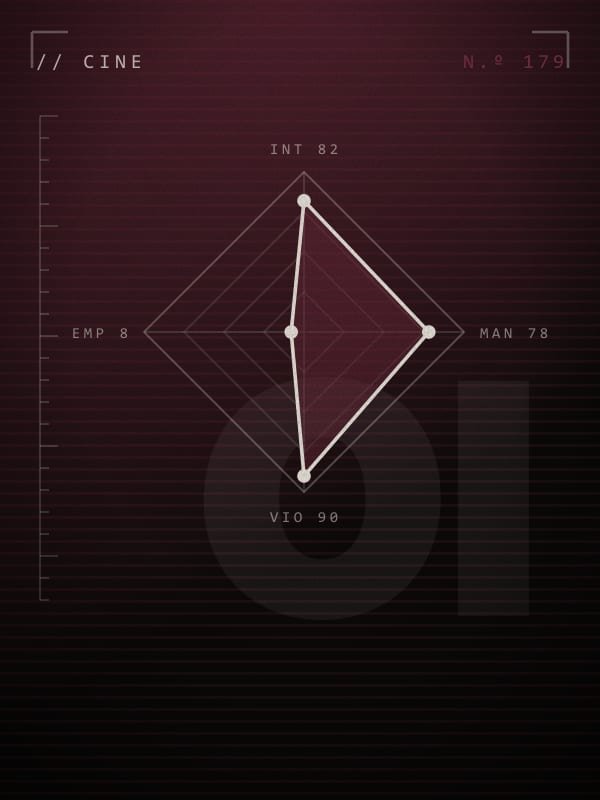
Ganondorf, the king of the Gerudo and eternal nemesis of The Legend of Zelda, is usually presented as evil incarnate, the cyclical embodiment of greed. But his origin holds a tension that Elliott's integrated theory knows how to read: Ganondorf does not spring from a void, but from a structural injustice. He is the king of a people, the Gerudo, condemned to survive in a barren and hostile desert while the neighboring kingdom of Hyrule flourishes in abundance. That collective tension —that of an entire people frustrated by its lot— breaks his loyalty to the order of the world, and that rupture hurls him to seek the power —the Triforce— that promises to redefine a distribution he judges unjust. The trajectory of the one who rebels, at least at first, not for himself but in the name of a shared injustice.
// The theoryThe tension that belongs not to one, but to all
Elliott's integrated theory inherits from Merton's strain the idea that the frustration of legitimate goals pushes toward crime, and adds that this tension can be structural and collective, not just an individual drama. Ganondorf embodies that collective version. The Gerudo are not poor out of laziness or malice: they are poor because of a structure —they were born in a desert that yields no food, while a step away Hyrule enjoys fertile lands, wealth and the favor of the gods—. That is a textbook Mertonian strain: the goal (to prosper, to live with dignity) is universal, but the legitimate means to reach it are, for the Gerudo, structurally blocked by geography and by the distribution of the world. Ganondorf, as king, embodies and channels that frustration. The collective tension erodes his loyalty to the established order: why respect a world that condemned his people to the sand while blessing another with abundance? And that broken loyalty pushes him to the final link: to seek the absolute power that would let him rewrite the rules of a distribution he perceives —not without reason— as an injustice of origin.
The real injustice that ambition devours
Ganondorf illustrates a subtle and dangerous mechanism of integrated theory: how a legitimate tension can set off a chain that ends in an illegitimate crime. Ganondorf's starting point holds an uncomfortable truth: the inequality between the Gerudo desert and prosperous Hyrule was unjust, and his rebellion against that order is born of a real grievance. But integrated theory shows that the just origin of a trajectory does not sanctify its destination. The collective tension broke his loyalty to the order, yes; but on reaching the link of power, the people's cause dissolved into the man's ambition. Ganondorf stops wanting justice for the Gerudo and comes to want to dominate everything: the vindication becomes conquest, the reparation becomes tyranny. This is the pattern the theory lets us see: a real structural injustice ignites a real tension, which breaks real bonds, but the power sought to remedy it ends up devouring the original end and replacing it with pure domination. The lesson is twofold and difficult: one must take seriously the injustice that ignites the chain —denying it is to understand nothing— and at the same time judge the crime the chain leads to —because having a just cause does not authorize razing the world—.
Get the map of theories for free
Subscribe to the criminal archive —one case a week, no spam— and I'll send you The map of theories: the great currents of criminology on a single sheet.
// The subjectThe king who confused his people with his power
What makes Ganondorf tragic, and not merely evil, is that he begins as a king —responsible for a condemned people— and ends as a tyrant who no longer serves anyone but himself. In his origin, the Gerudo's frustration and his own were one and the same; his struggle had a collective subject. But as he travels the chain toward power, the "we" shrinks until it becomes an "I": he stops seeking his people's prosperity and comes to seek his own reign. Integrated theory explains that slippage: when the rupture of bonds with the conventional order combines with the pursuit of absolute power, the collective cause tends to be subordinated to individual ambition, because power is not shared —it is concentrated—. Ganondorf confused liberating his people with dominating the world, and in that confusion he lost whatever was legitimate in his rebellion. The king who spoke in the name of the wind of death that blew over his desert ended up being, himself, the wind of death that blows over everyone.
Ganondorf
// The crackNeither cyclical evil without cause, nor a righteous rebel absolved
The crack with Ganondorf has two faces, and both are tempting. The first is to treat him as evil incarnate, the cyclical greed that reappears era after era with no explanation beyond its nature —which erases the real structural tension from which it is born and turns him into a stage-prop villain—. The second, more modern, is to absolve him as a righteous rebel: "his people were condemned to misery, his rebellion is legitimate, Hyrule is the true oppressor". Both fail. The injustice against the Gerudo was real, and to deny it —as the first reading does— is to fail to understand the chain. But that injustice does not make legitimate what Ganondorf does with it: seeking absolute power and subjugating the entire world, including innocents who had nothing to do with the desert's lot. Having a real grievance does not authorize tyranny. Integrated theory holds both truths: the tension that ignites the chain can be just and the crime it leads to can be unjustifiable, and to confuse one with the other —to deny the grievance or excuse the crime— is to betray the analysis.
The honest reading does not choose between pitying the Gerudo people and condemning the tyrant their king became: it does both. Explaining that a people's misery can beget a conqueror does not excuse the conqueror; it points to the injustice that would have to be repaired so that the chain is not ignited —and to the line that not even the most aggrieved has the right to cross—.
Repairing the injustice before it begets the tyrant
Ganondorf matters because he shows the most uncomfortable cutoff point of integrated theory: structural injustice itself. His chain does not begin in personal wickedness, but in an inequality of origin —a people condemned by its geography while another prospers—. The theory teaches that ignoring that collective tension, treating it as if it did not exist or blaming only the villain it produces, guarantees that the chain will ignite again: as long as the desert remains barren and Hyrule prosperous, era after era a new Ganondorf will arise to channel the same frustration. The real cutoff point is not in defeating the tyrant again and again (the saga's eternal cycle is, at bottom, the proof of a failure), but in repairing the structural injustice that begets him before it begets another. That is the political lesson of integrated theory: the chains born of collective grievances are not cut only by punishing whoever travels them to the end, but by attending to the tension of origin —because an unrepaired injustice is a factory of villains, and no hero is enough to defeat them all if the factory stays open—.
Three key ideas
- Ganondorf embodies the COLLECTIVE TENSION of integrated theory (Elliott, rooted in Merton): king of the Gerudo, a people condemned to the misery of a barren desert while Hyrule prospers. That structural injustice breaks his loyalty to the order of the world and hurls him to seek the power that promises to rewrite the distribution.
- He shows how a legitimate tension sets off a chain that ends in an illegitimate crime: the injustice against the Gerudo was real, but on reaching power the people's cause dissolves into the man's ambition —vindication becomes conquest, the "we" shrinks to an "I"—.
- Neither cyclical evil without cause (it is born of a real structural injustice) nor a righteous rebel absolved (the grievance does not authorize tyranny over innocents). The cutoff point is to repair the injustice of origin: an unrepaired injustice is a factory of villains, and no hero is enough if the factory stays open.
Sources · further reading
- Merton, R. K. (1938). Social Structure and Anomie. American Sociological Review.
- Elliott, D. S., Huizinga, D., & Ageton, S. S. (1985). Explaining Delinquency and Drug Use. Sage.
- Agnew, R. (2006). Pressured into Crime: An Overview of General Strain Theory. Oxford University Press.
Case-file questionsFrequently asked questions
¿Quién es Ganondorf?
Ganondorf («—») es un villano de The Legend of Zelda, analizado en KRIMINIS con la lente de la criminología. He was not born resentful: he was born in a barren desert while the neighboring kingdom flourished.
¿Por qué Ganondorf (—) se convierte en villano?
Ganondorf and integrated theory: the tension is not individual, but collective. A people condemned to the misery of the desert while others prosper. That structural frustration breaks their king's loyalty to the order of the world, and hurls him toward the power that redefines everything.
¿Qué teoría criminológica explica a Ganondorf?
El caso de Ganondorf se analiza desde la Patrón Interactivo Integrado. Integrated theory (Elliott) admits that tension can be collective, not only individual. Ganondorf, of The Legend of Zelda, embodies it: king of a people, the Gerudo, condemned to the misery of a barren desert while Hyrule prospers. That structural frustration breaks his loyalty to the order of the world, and that rupture hurls him to seek the power —the Triforce— that redefines everything. The trajectory of the one who rebels not for himself, but in the name of a shared injustice that his ambition later devours.