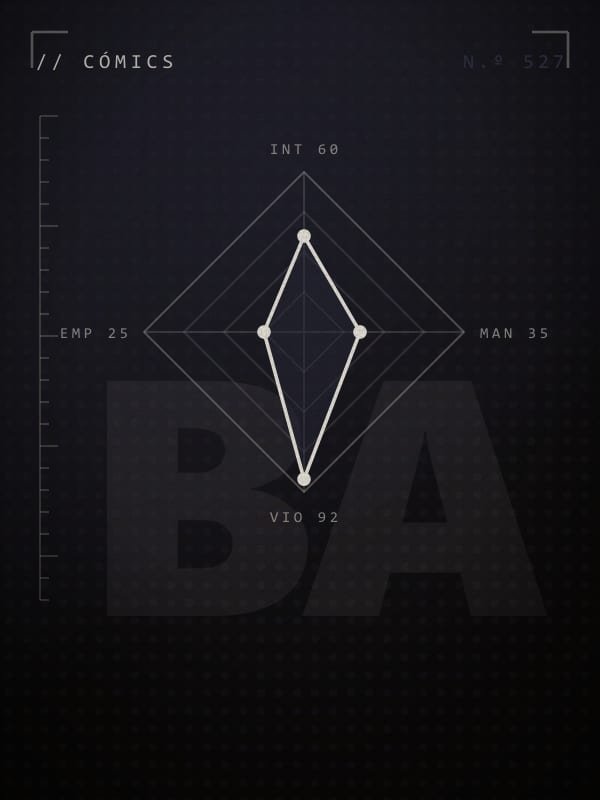
Slade Wilson was not born taking aim. He was an army soldier —young, disciplined, obedient— whom the institution taught to move in combat, to read a target, and to pull the trigger without his pulse wavering. Then came the military experiment that multiplied his reflexes and his strength, and finally the market: when he discovered there were people who paid fortunes for what he already knew how to do, Slade Wilson became Deathstroke, the deadliest mercenary in the DC universe. The question this character poses is not «why is he so violent?», but something more uncomfortable: where did he learn to be? And the answer, for social learning theory, is written in his service record before it is written in his genes.
// The theoryViolence is learned like a trade
Social learning theory starts from a simple, devastating idea: violent behavior is not an instinct that springs up nor a defect that is inherited, but something that is learned, by the same mechanisms with which one learns a language or a trade. Albert Bandura, with his famous Bobo doll experiment (1961), showed that children imitated an adult’s aggression —and all the more so if that adult was admired or if his violence had been rewarded—. Years later, Robert Burgess and Ronald Akers (1966) carried that idea into crime and fused it with Sutherland’s differential association and Skinner’s operant conditioning. Akers’s mature model brings together four gears: differential association (who you keep company with), definitions (what you are taught to think of crime), differential reinforcement (what your environment rewards and punishes), and imitation (whom you copy). Slade Wilson passes through all four with almost textbook clarity. He kept company with soldiers and, later, with other mercenaries. He absorbed the definitions of a world where killing on orders is a duty and, later, a service. He saw violence rewarded first with medals and promotions, then with million-dollar contracts. And he imitated the models that environment elevated: the effective officer, the operative who completes the mission and comes back in one piece.
From uniform to contract: the same behavior, a different payer
What makes Deathstroke a perfect case is the transfer: the behavior he learned in a socially legitimate context —the army— he carries over intact to a criminal one —mercenary work—. The technique is identical; only who signs the check changes. Social learning theory explains exactly that: we do not learn «isolated acts», but repertoires of behavior together with the definitions that justify them. Slade was taught to see selective assassination as clean, depersonalized, «professional» work; a task carried out without hatred and without guilt. That moral neutralization —killing is a mission, not a crime— is a learned favorable definition, and it is what lets him move from the military target to the paid target without feeling he has crossed any line. When Deathstroke insists that he is «not a killer, but a professional», he is not lying: he is reciting the lesson he internalized. The uniform gave him the script; the market only changed who was on the receiving end of the shot.
Get the map of theories for free
Subscribe to the criminal archive —one case a week, no spam— and I'll send you The map of theories: the great currents of criminology on a single sheet.
// The subjectThe pupil who surpassed the school
Deathstroke is not a psychopath who discovers the pleasure of killing: he is a skilled worker who perfected his trade to the point of excellence. He is methodical, he studies his targets, he plans each operation like a campaign, and he despises botched work and the amateur. That ethic of performance —the obsession with doing the job well— is, once again, learning: the army did not only teach him to kill, it taught him to do it with discipline, with protocol, with the pride of a guild. The most revealing detail of the character is his role as teacher: Slade trains, drills, and uses young people —sometimes his own children, sometimes kids he recruits— for the same trade. With this the villain closes the circle the theory describes: the one who was modeled becomes a model, and reproduces in the next generation the same behaviors, reinforcements, and definitions he absorbed. Violence is not only learned: it is passed on. And Slade, who learned by watching his superiors, is now the superior others watch to learn how to kill for money.
Deathstroke
// The crackTraining does not compel: to explain is not to excuse
Here the crack appears, and it is large. Thousands of people pass through the army, receive the same drilling, absorb the same definitions… and do not end up selling themselves to the highest bidder to murder innocents. Learning explains where Slade’s capacity came from and why violence felt natural to him; it does not explain —nor excuse— the choice to place it at the service of crime. The theory itself, in its social-cognitive version, admits as much: Bandura abandoned pure behaviorism precisely to insist that we are not passive sponges. Mental processes intervene —attention, retention, motivation— and, above all, agency intervenes: we choose which models to follow, we interpret what we see, and we decide whether to act. Slade Wilson chose. He chose every contract, every target, every child he dragged into his trade. The environment put the weapon in his hand and taught him to use it; pulling the trigger for money was, every time, a decision of his own.
That is why the honest reading holds two things at once. Understanding that Deathstroke’s violence is learned behavior —modeled by an institution, reinforced by a market, armored by definitions that called it «professionalism»— does not turn him into a victim of the system or an innocent cog. On the contrary: understanding how a hired killer is manufactured points more precisely to the responsibilities, his and those of the environments that reward and elevate effective violence. To explain is not to excuse. The memory that matters is not that of the mercenary admired for his technique, but that of all those he executed as if they were just one more box on a contract.
If it is learned, it can be unlearned (and it can go untaught)
The strength of social learning theory is its uncomfortable optimism: if violence is learned, it can also be unlearned —and, above all, it can go untaught—. Deathstroke forces us to look beyond the individual, toward the institutions that manufacture the capacity to kill and then lose control over where that capacity ends up. The soldier who becomes a mercenary, the operative trained by a State who ends up selling his services, the youth recruited and drilled by a master of crime: these are variations of the same mechanism. The lesson is not to demonize training, but to recognize that every school of violence creates models, and that models are imitated. A society that rewards lethal efficiency and admires the one who kills «with style» is writing, without knowing it, the syllabus for the next Deathstroke. Against the «born killer» marked from birth, this theory recalls something more useful and more demanding: nobody is born taking aim, and that is why it matters who teaches, what gets rewarded, and whom we hold up as an example.
Three key takeaways
- Deathstroke (Slade Wilson) illustrates social learning theory (Bandura; Akers): violence is not an instinct, but learned behavior —modeled in the army, reinforced by the paycheck, and justified by definitions that call it «professionalism»— and transferred from the uniform to the contract.
- He passes through Akers’s four gears —association, definitions, differential reinforcement, and imitation— and closes the circle by becoming a teacher: the modeling he received he passes on to the young people he drills for the same trade.
- To explain is not to excuse. Learning gives the capacity; the choice is his. Thousands receive the same training and do not kill for money: Slade chose every target. The memory belongs to his victims, not to the mercenary.
Sources · further reading
- Bandura, A., Ross, D. & Ross, S. A. (1961). «Transmission of Aggression through Imitation of Aggressive Models». Journal of Abnormal and Social Psychology, 63(3).
- Burgess, R. L. & Akers, R. L. (1966). «A Differential Association-Reinforcement Theory of Criminal Behavior». Social Problems, 14(2).
- Bandura, A. (1977). Social Learning Theory. Prentice-Hall.
- Akers, R. L. (1998). Social Learning and Social Structure: A General Theory of Crime and Deviance. Northeastern University Press.
Case-file questionsFrequently asked questions
¿Quién es Deathstroke?
Deathstroke («Slade Wilson») es un villano de DC Comics, analizado en KRIMINIS con la lente de la criminología. Nobody is born knowing how to kill with a single shot from two hundred meters.
¿Por qué Deathstroke (Slade Wilson) se convierte en villano?
Deathstroke (Slade Wilson) and social learning theory: how violence is learned like a trade —modeled in the army, reinforced by the paycheck— and transferred to the market for contract killing.
¿Qué teoría criminológica explica a Deathstroke?
El caso de Deathstroke se analiza desde la Aprendizaje social. Social learning theory (Bandura; Burgess and Akers) holds that violent behavior is neither an instinct nor a destiny, but something learned by observing models, imitating what gets rewarded, and absorbing the definitions an environment treats as normal. Deathstroke —Slade Wilson, the soldier subjected to a military experiment that turned him into the deadliest mercenary on the planet— is a textbook case: he learned the technique and the ethics of killing in the army, and he perfected them as a trade when he discovered the market would pay for them. His professional coldness is not an anomaly: it is trained, reinforced behavior transferred from a legitimate context to a criminal one.