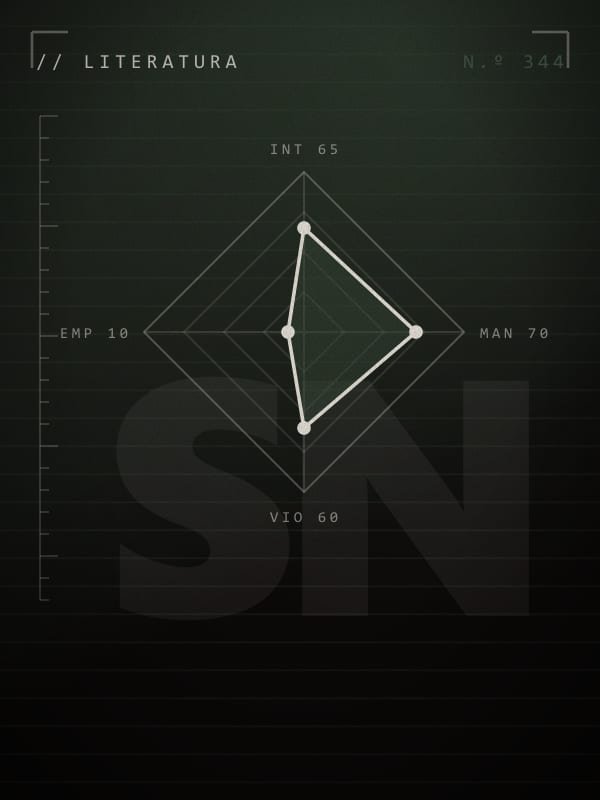
Cypher is part of the crew that has awoken from the Matrix into harsh reality. But he longs for the simulation: the good food, the comfort, the ignorance. So he cuts a deal with the agents: he will hand over his crewmates—including his leader, Morpheus—in exchange for having his memory erased and being returned to the lie. And he does it without a fit of rage, with a reasoned calm, dining on a steak he knows is fake while he explains why he prefers the illusion. For cognitive criminology, Cypher is the reasoned betrayal: crime as the logical conclusion of a comfortable premise.
// The theoryThe syllogism that sets up the betrayal
The cognitive criminology of Yochelson and Samenow distinguishes the subsequent excuse (the one we give after the mistake) from the prior rationalization that makes the act thinkable. Cypher shows it with textbook clarity: he does not betray and then justify it; first he builds the syllogism —"reality is pain; the simulation is pleasure; therefore choosing the simulation is sensible"— and from that premise, selling out his friends follows coldly. His famous line, "ignorance is bliss", is not an improvised alibi: it is the axiom from which he decides. The distortion does not cleanse his conscience afterward; it switches it off beforehand.
The coherence of cowardice
What is disturbing about Cypher is that his reasoning has an undeniable internal coherence: if pleasure truly is worth more than truth, his choice is "logical". Cognitive criminology points to a fine distinction here: thinking errors are rarely formal failures of logic, but rather poisoned premises that, once accepted, drag terrible conclusions along with impeccable correctness. Cypher does not deduce badly; he starts badly—from an axiom that reduces his entire life to comfort and erases the worth of his crewmates. That is why arguing with him about his acts would be useless: what one would have to argue about is his premise. In him, cowardice is not a tremor: it is a theorem.
// The subjectThe disillusionment that became an excuse
Cypher is not a monster: he is an exhausted, disillusioned man who cannot bear the weight of the truth he was shown. His distortion is born of real suffering—the desolation of reality after the illusion. Cognitive criminology recognizes that root, but does not accept it as a free pass: the weariness explains why he built his syllogism, it does not justify condemning his crewmates to death to escape it. Many carry disillusionments just as harsh without selling out anyone. Cypher chooses to turn his pain into a premise that gives him permission to betray.
Cognitive criminologists catalogued specific thinking errors, and in Cypher the one Yochelson and Samenow called the cutoff operates with clarity: a brief phrase that abruptly silences any moral hesitation. "Ignorance is bliss" is not only his axiom; it is the switch that shuts off guilt just before he signs the pact. To that cutoff is added a hedonism elevated to a sole criterion: the pleasure of the steak, the wine, the oblivion, weighed against Morpheus's life and resolved in favor of the palate. What makes his stance criminogenic is not desiring comfort (anyone desires it), but having turned it into the only yardstick by which he measures the worth of everything else, including the people who sleep beside him aboard the Nebuchadnezzar.
Comfort as a premise, not as a crime
It is worth not confusing the desire for comfort with the crime. Wanting to rest from an exhausting truth is not criminogenic; what is criminogenic is raising that desire to a major premise that subordinates others. Cognitive criminology does not pathologize Cypher's longing for peace: it points to the exact leap at which that longing stops being a feeling and begins to function as a rule that authorizes harm. There—and not in the weariness—lies the line that separates the broken man from the traitor.
And yet, a counterexample is needed to dismantle easy determinism: the same crew shares Cypher's raw reality—the gray gruel, the cold of the ship, the perpetual grief—and none of them strikes a deal to hand over a crewmate. If the conditions compelled betrayal, everyone would betray; they do not. Cypher's premise does not spring from the facts, but is chosen among several possible readings of those same facts. That is why cognitive criminology insists that the premise is chosen, not suffered: reconstructing the syllogism that makes betrayal thinkable illuminates the mechanism, but does not absolve it, because that same mechanism was within reach of others who rejected it.
Cypher
Get the map of theories for free
Subscribe to the criminal archive —one case a week, no spam— and I'll send you The map of theories: the great currents of criminology on a single sheet.
// The riftNeither "he had a point", nor "he was just weak"
The rift with Cypher is letting yourself be seduced by his coherence: "deep down he has a point, who wouldn't sometimes rather not know?". Cognitive criminology defuses the trap: his reasoning is valid only if you accept his poisoned premise (that his own comfort is worth more than the lives of others), and that is precisely where the error lies. The opposite rift is to dismiss him as "just a weak man". No: he is a weak man who reasons his weakness and acts on it with premeditation—he negotiates, plans, carries out the handover. The distortion explains why it seems sensible to him; it does not erase that he lucidly chooses betrayal.
That Cypher dines on his fake steak while he seals the pact is the exact image of his cognitive style: deliberately savoring a lie he has decided to prefer. Cognitive criminology asks us to look at that scene not with contempt nor with sympathy, but with precision: there it is, served on a plate, a thinking error anyone can recognize in its everyday versions—every time someone chooses the comfortable illusion at another's expense and calls it common sense.
Argue the premise, not the act
Cypher matters because he teaches where the battle against a certain kind of crime is won or lost: not in the acts, but in the premises. With someone who betrays by a syllogism, punishing the act does not touch the cause—next time he will deduce the same thing again. Cognitive criminology and the therapy born from it work one level below: they bring the hidden premise to light ("my comfort is worth more than others") and call it into question. It is slow and frustrating, because the premise feels like common sense to whoever holds it. But it is the only point at which a reasoned betrayal can, truly, be disarmed.
Three key takeaways
- Cypher is cognitive criminology's reasoned betrayal: he hands over his friends to return to the simulation and justifies it with a sincere syllogism ("ignorance is bliss"). He rationalizes before acting, not after.
- His error is not logical but one of premise: if you accept that his own comfort is worth more than another's life, everything follows coherently. Cowardice turned into a theorem.
- Neither "he had a point" (the trap is in his poisoned premise) nor "he was just weak" (he reasons and executes with premeditation). With this profile you have to argue the premise, not the act.
Sources · further reading
- Yochelson, S. & Samenow, S. E. (1976). The Criminal Personality. Jason Aronson.
- Sykes, G. & Matza, D. (1957). “Techniques of Neutralization”. American Sociological Review, 22(6).
- Baudrillard, J. (1981). Simulacra y simulación.
Case-file questionsFrequently asked questions
Who is Cypher?
Cypher (“Mr. Reagan”) is a villain from The Matrix, analysed on KRIMINIS through the lens of criminology. He prefers the fake steak to the bitter truth.
Why does Cypher (Mr. Reagan) become a villain?
Cypher and cognitive criminology: the reasoned betrayal. A man who sells out his friends in exchange for a return to a comfortable lie, and does so with a perfectly sincere syllogism.
Which criminological theory explains Cypher?
Cypher's case is analysed through Cognitive criminology. Cognitive criminology holds that crime is born of rationalizations that precede the act. Cypher, from The Matrix, is the reasoned betrayal: he hands over his crewmates in exchange for being returned to the simulation, and justifies it with a sincere syllogism —"ignorance is bliss"—. He does not betray in a fit of rage: he arrives at it by deduction.