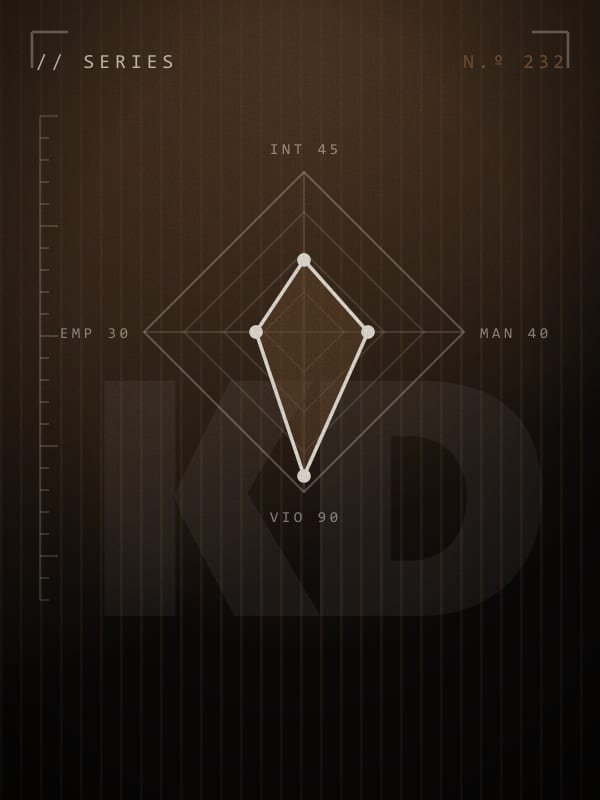
Sonny Corleone does not calculate: he reacts. When his brother-in-law abuses his sister, he goes to beat him up in broad daylight; when he is humiliated, he explodes without weighing the risk. In a family that turns cold control into an art, Sonny is the one who acts before he thinks — and that impulsivity, more than any enemy, is what kills him at a tollbooth, lured into an ambush by his own predictable fury. Sonny is the exact portrait of what the theory of low self-control considers the root of crime.
// The theoryImpulsivity as the root
Gottfredson and Hirschi (1990) argued that the common factor behind almost all crime is low self-control: the tendency to act on impulse, to seek immediate gratification, to take risks without calculating them and, above all, to explode easily. Sonny ticks every one of those boxes. He is not stupid or cowardly (he is brave and loyal), but he lacks the brake that separates impulse from action. Where his father and his brother Michael think before they move, Sonny moves and then, if at all, thinks. In a business where survival depends on cold blood, that lack is not a mere quirk of character: it is his Achilles' heel.
The brilliance of The Godfather is that it turns the Corleone family into a laboratory of self-control. Vito is the master of patient calculation; Michael, the heir to that coldness taken to a glacial extreme; and Sonny, the counterexample—the one who has the same power and the same violence available, but without the ability to administer it. His temperament makes him predictable, and in the mafia chess game the predictable is lethal: his enemies know it is enough to provoke him (to abuse his sister) to draw him out of his lair into a trap. Sonny does not die from a lack of courage or strength; he dies from an excess of impulse. His anger, his best weapon in a fight, is his worst adviser in a war.
The cost of the one who cannot wait
Sonny adds a valuable nuance to the theory of low self-control: impulsivity not only pushes toward crime, it also makes the offender vulnerable. In the criminal world, where everyone is dangerous, the advantage is not given by violence—everyone has that—but by control over when and how to use it. The one who cannot wait, who bites every hook, who responds to every provocation, becomes the easiest piece to eliminate. Michael survives and prospers because he masters impulse to the point of cruelty; Sonny falls because he cannot. The same family, the same strength: the difference is the brake. The theory sums it up well — low self-control is a bad deal even for a criminal.
// The subjectThe warm heart of a cold family
What makes Sonny endearing—and his death, painful—is that his impulsivity is inseparable from his virtues. The same lack of restraint that condemns him is what makes him passionate, loyal, incapable of staying still while his sister is being hurt. His empathy, in fact, is high (higher than Michael's): he feels too much and too fast, and that is why he cannot contain himself. Sonny is not a cold psychopath or a cruel calculator; he is a hot-blooded man in a cold-blooded business, and that mismatch kills him. Here the theory of low self-control touches something human: impulsivity is not always malice, sometimes it is an excess of heart without the brake to govern it. Sonny wanted to protect his own; his tragedy is that the way he did it—with his fists, without thinking—was precisely the one that delivered him to his enemies. He died as he lived: reacting.
Sonny Corleone
Get the map of theories for free
Subscribe to the criminal archive —one case a week, no spam— and I'll send you The map of theories: the great currents of criminology on a single sheet.
// The crackOnly self-control?
The theory of low self-control is powerful, but explaining Sonny only through his impulsivity ignores the rest: he was born into a mafia family (learning, opportunity), in a culture of honor that rewards responding to affronts—his anger is not only an individual trait, but also an internalized subcultural norm—. Besides, the theory assumes self-control is fixed in childhood, yet impulsive people learn to manage themselves with age. And its usual circularity lurks: do we know Sonny had low self-control from anything other than his impulsive conduct? The solid version is the modest one: impulsivity weighed, and heavily, on Sonny's fate — but alongside family, culture and situation, not alone.
The brake can be trained
If low self-control is behind so much crime and so much self-destruction, the good news is that the brake can be trained. Anger regulation, the ability to pause between stimulus and response, frustration tolerance: these are skills that can be taught and that real programs—in parenting, in cognitive-behavioral therapy, in anger management—have been shown to improve, even in adults. Sonny never had that chance; his world celebrated impulse as manhood and punished with death anyone who showed it. The lesson it leaves is twofold: how much damage ungoverned impulsivity does, and how much would be gained by teaching, from childhood, the boring but life-saving art of counting to ten before acting. It would have saved Sonny's life.
Three key takeaways
- The theory of low self-control (Gottfredson and Hirschi) sees impulsivity—exploding without thinking, not weighing consequences—as the root of crime. Sonny embodies it in a family of cold calculators.
- His lack of restraint not only pushes him toward violence: it makes him predictable and vulnerable. Provoking him (abusing his sister) is enough to lure him into the trap that kills him. In crime, self-control is the real advantage, not violence.
- The crack: not only self-control—also family, culture of honor, situation. But its lesson is hopeful: the brake (regulating anger, tolerating frustration) can be trained. It would have saved Sonny's life.
Sources · further reading
- Gottfredson, M. R. & Hirschi, T. (1990). A General Theory of Crime. Stanford University Press.
- Pratt, T. C. & Cullen, F. T. (2000). “The Empirical Status of Gottfredson and Hirschi's General Theory of Crime”. Criminology, 38(3).
- DeWall, C. N. et al. (2007). “Violence Restrained: Self-Regulation and Aggression”. Journal of Experimental Social Psychology, 43(1).
- Novaco, R. W. (1975). Anger Control. Lexington Books.
Case-file questionsFrequently asked questions
Who is Sonny Corleone?
Sonny Corleone (“Sonny”) is a villain from The Godfather, analysed on KRIMINIS through the lens of criminology. Sonny Corleone does not calculate: he reacts.
Why does Sonny Corleone become a villain?
The Godfather and low self-control: Sonny Corleone is brave, loyal and lethal, but his inability to master his anger makes him the weak point of a family of cold calculators — and it ends up costing him his life. Impulsivity as the fatal flaw.
Which criminological theory explains Sonny Corleone?
Sonny Corleone's case is analysed through Low self-control. Gottfredson and Hirschi's theory of low self-control identifies impulsivity—acting without thinking about consequences, exploding easily, seeking immediate gratification—as the common factor behind almost all crime. Sonny Corleone is its tragic illustration: within a mafia family that survives thanks to calculation and self-control, he is the one who cannot master his anger, and that lack of restraint makes him a danger to his own people and, finally, a corpse. It shows that low self-control does not only push toward crime: in the criminal world, it is a death sentence.