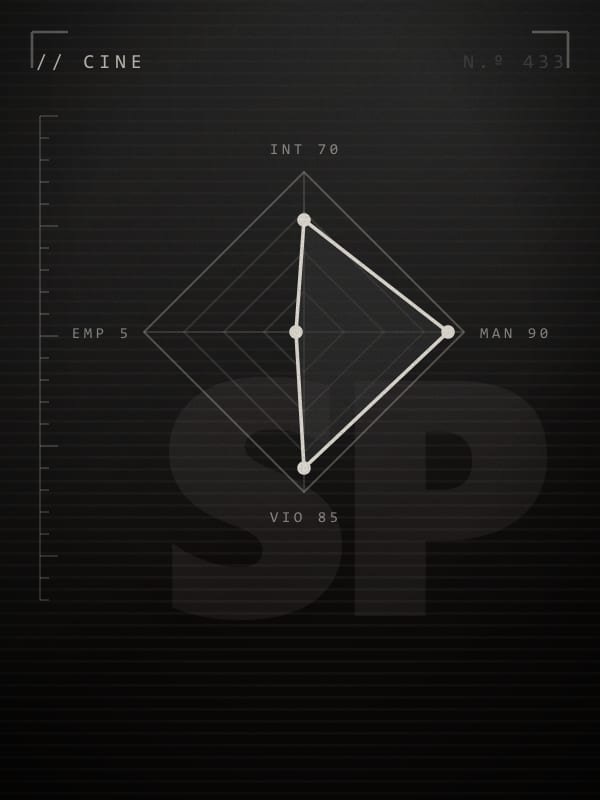
The Titty Twister is a roadside bar in the middle of the Mexican desert, open till dawn, loud, packed with truckers and bikers. Its star is Santánico Pandemónium, a hypnotic dancer who, midway through her act, reveals what the place really is: a vampire queen, and the whole bar a trap to devour everyone who walks through the door. In From Dusk Till Dawn, the Titty Twister is not a dive where crimes happen: it is an establishment whose business model is crime. For the theory of risky facilities, Santánico and her bar are the purest form of the bait-venue: the facade of service that exists solely to trap the victim.
// The theoryThe legitimate facade over the trap
Eck and Clarke drew a distinction between the honest, poorly managed venue —which tolerates crime through negligence— and the venue designed from the outset as an instrument of crime. The Titty Twister is the second case taken to the extreme. It deliberately gathers every driver of risk: isolation (no one hears anything in the desert), anonymity and turnover (a passing clientele no one will miss), absence of guardians (the only «watchmen» are the predators) and an attractive facade (music, alcohol, dancing) whose sole purpose is to bait the trap. The lesson of the theory is that the facade is not decoration: it is the tool. A bar that offers exactly what the weary traveler is looking for —shelter, a party, a drink— turns its hospitality into a lure. The venue does not wait for crime: it manufactures it by drawing in the prey.
When the service is the lure
Santánico reveals an uncomfortable principle of risky facilities: that the very traits that make a venue attractive —accessibility, late-night opening, atmosphere, alcohol— are also the ones that can turn it into a magnet for crime. The Titty Twister takes it to the absurd (it serves its customers… as the main course), but the mechanism is real: the high-risk bars studied by Eck and Clarke concentrate violence precisely because of their combination of alcohol, crowding, late opening and management that prioritizes business over safety. The key lies in the intention of the management: an honest bar can correct those traits (crowd control, security, closing at reasonable hours); the Titty Twister does not want to correct them, because they are its hunting tool. The theory teaches us to read the difference: to ask whether a venue suffers its risks or exploits them. When the «service» is designed to lure the victim to the point where no one can help them, the establishment has ceased to be a business with a crime problem and has become, itself, the weapon of the crime.
Get the map of theories for free
Subscribe to the criminal archive —one case a week, no spam— and I'll send you The map of theories: the great currents of criminology on a single sheet.
// The subjectThe manager who is also the predator
Santánico is not an employee of the venue: she is its queen, management and predator fused into a single figure. That makes her the extreme case of the theory's «criminogenic manager». In the mild version, the manager is a negligent owner who skimps on security; in the intermediate one, an accomplice who profits from the illicit activity he houses; in the extreme —Santánico— the manager is the one who commits the crime, and the entire establishment is organized as her hunting ground. Her hypnotic dance is the most telling part: it is the moment when the venue lowers the victim's defenses, seduction turned into the architecture of deception. Santánico runs the Titty Twister as a perfect ecosystem of predation —every element, from the neon sign to the music, calibrated to attract, retain and consume—. She is the risky facility that has erased the distance between the place and whoever profits from it: here, the place and the criminal are one and the same.
Santánico Pandemónium
// The crackNot every roadside bar, nor a neutral venue
The crack when reading the Titty Twister is twofold. On the one hand, the panic that stigmatizes: concluding that every roadside bar, every late-night dive, is a trap —when the vast majority are honest businesses the theory would never flag—. Eck and Clarke insisted that the risky-facility label requires data and concentration, not prejudice about the type of venue. On the other hand, the opposite crack: the naivety of treating any establishment as a neutral space where crime «just happens», ignoring that some are designed or managed to exploit their clientele. The honest reading tells one from the other: the bar that suffers incidents despite doing things right, from the bar whose business is harm. Santánico is the caricature of the second, and her pedagogical value lies there: reminding us that behind a facade of hospitality a trap may hide, without therefore suspecting all hospitality.
That the tool of the crime is seduction —the dance, the music, the drink offered— and not brute force, is what makes the Titty Twister such a sharp lesson: the most dangerous venue is not the one that threatens you at the door, but the one that invites you in.
Reading the intention of an establishment
Santánico matters because she teaches us to ask about the intention of the venue: does this place suffer crime or exploit it? Most real risky facilities lie in the gray zone of negligence —managers who do not invest in security, who tolerate what they should not—, but the theory also contemplates the extreme of the establishment designed as a trap, and that extreme teaches us to read the grays with more clarity. The Titty Twister, with its festive facade over the slaughterhouse, is the reminder that a business can use its service as a lure, and that the safety of a place is not measured by how welcoming it seems, but by what happens to whoever trusts it. The practical lesson: faced with a venue that concentrates harm, do not stop at the facade; ask who it truly serves, and who it truly serves up.
Three key takeaways
- Santánico Pandemónium runs the Titty Twister, the risky facility in its purest form: a roadside bar whose business model is devouring its clientele. The facade of a festive dive is the bait; the venue, the trap.
- It illustrates the venue designed from the outset for crime (as opposed to the honest, poorly managed one): isolation, anonymity, absence of guardians and a hospitality that is a lure. The same traits that make a bar attractive can turn it into a magnet for crime if management exploits them instead of correcting them.
- Neither stigmatize every roadside bar nor treat the venue as neutral. The question that matters: does this establishment suffer crime or exploit it? The most dangerous venue is not the one that threatens you at the door, it is the one that invites you in.
Sources · further reading
- Eck, J. E., Clarke, R. V. & Guerette, R. T. (2007). «Risky Facilities». Crime Prevention Studies, 21.
- Madensen, T. D. & Eck, J. E. (2008). «Violence in Bars: Place Manager Decision-Making». Crime Prevention and Community Safety, 10.
- Clarke, R. V. & Eck, J. E. (2005). Crime Analysis for Problem Solvers in 60 Small Steps. COPS.
Case-file questionsFrequently asked questions
¿Quién es Santánico Pandemónium?
Santánico Pandemónium («—») es un villano de Abierto hasta el amanecer, analizado en KRIMINIS con la lente de la criminología. A bar in the middle of the desert, open all night, full of truckers and bikers.
¿Por qué Santánico Pandemónium (—) se convierte en villano?
Santánico Pandemónium and the Titty Twister: the queen of a dive whose real business is devouring whoever walks in. The party facade over the trap, the venue designed as bait.
¿Qué teoría criminológica explica a Santánico Pandemónium?
El caso de Santánico Pandemónium se analiza desde la Instalaciones Criminógenas. Risky facilities (Eck and Clarke) show how certain venues concentrate crime through their design and management. Santánico Pandemónium, the queen of the Titty Twister bar in From Dusk Till Dawn, runs an establishment whose real business model is devouring its clientele. The venue as bait: the facade of a festive dive draws in the victim and the facility —isolated, without witnesses, run by the predators themselves— does the rest.