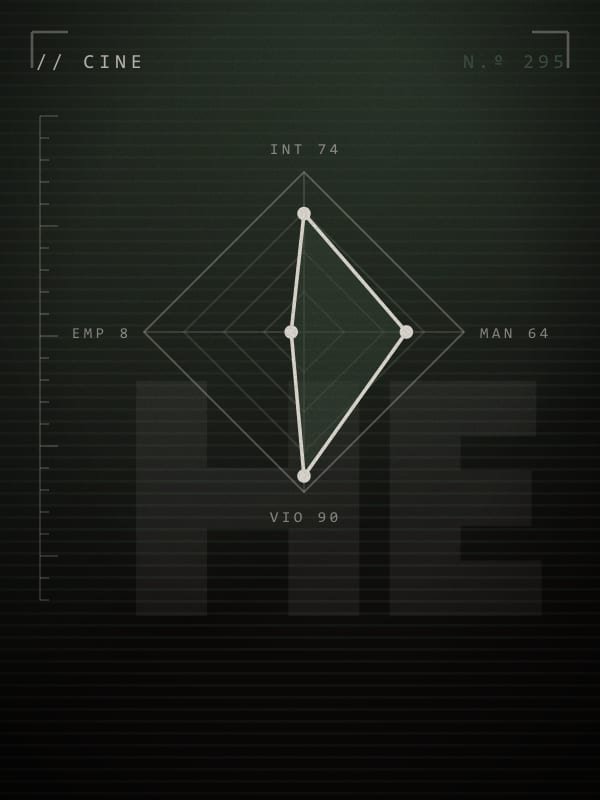
Pinhead —leader of the Cenobites in Hellraiser, the saga born of Clive Barker's novel— chases no one with a knife. He waits. Someone solves the box, the Lament Configuration, and then he appears: a face gridded with nails, an unhurried voice, without haste or rage. To whoever summons him he offers "pleasures and torments" without marking any difference between them, as if both were the same merchandise. He was once a man, Elliot Spencer, an officer broken by war who sought new sensations until he opened the box himself. What remains is a figure with no visible fury, no hatred and no recognizable enjoyment: only a trade. And that affective void beneath a perfect calm is, for psychopathy, the very core of the profile.
// The theoryThe mask of sanity and the affective factor
The psychiatrist Hervey Cleckley, in The Mask of Sanity (1941), described psychopathy as an impeccable façade of normality mounted over the absence of the deep emotions that anchor everyone else: guilt, fear, attachment, remorse. It is not "being insane" nor being by definition a murderer; it is a measurable personality profile. Robert Hare made it quantifiable with the PCL-R, which separates two factors: one interpersonal-affective —superficial charm, grandiosity, manipulation, lack of empathy and remorse— and another behavioral —impulsivity, irresponsibility, antisocial trajectory—. Pinhead is, almost by the book, the pure affective factor. There is in him no impulsivity or disorder: there is a glacial serenity. When he takes hold of the body of the one who called him, he does not do so with the excitement of the furious sadist nor the hatred of the avenger, but with the distant courtesy of someone processing a formality. He dispenses agony like someone reading a contract, and that disconnection between the horror he causes and the emotion he does not feel is the Cleckleyan definition of affective coldness.
Instrumental sadism: pain as a means
It is worth distinguishing two things that fiction tends to blend. Passionate sadism enjoys the suffering of others as an end in itself: it delights, it grows heated, it needs it. Instrumental sadism, by contrast, uses cruelty as a means —toward a goal, a ritual, a function— without any great emotional charge involved. Pinhead sits unsettlingly close to the second pole: he does not seem to enjoy pain like a raging torturer, but to administer it as part of a liturgy he himself does not question. "No tears, please; it's a waste of good suffering," he all but says: torment is not pleasure, it is raw material for a job. That failure to distinguish pleasure from pain —offered in the same voice— is precisely what makes him legible through psychopathy: where we see an absolute moral border, he sees two variants of the same sensation, without the affective brake that in anyone with intact empathy would make inflicting another's pain unbearable.
Get the map of theories for free
Subscribe to the criminal archive —one case a week, no spam— and I'll send you The map of theories: the great currents of criminology on a single sheet.
// The subjectFrom the broken man to the faceless officiant
What is revealing about Pinhead is that he was human. The saga insists that Elliot Spencer, jaded and seeking ever more extreme stimulation, opened the box and let himself be remade. That story is a powerful narrative temptation: it suggests the coldness had an origin, a before and an after, a man who chose to switch himself off. But the character who remains barely keeps a trace of the officer: the transformation erases the biography and leaves the profile laid bare. In Hare's terms, Pinhead exhibits the affective factor in an almost chemically pure state —total absence of empathy and remorse— without the impulsive, chaotic drift of the behavioral factor. He does not lie to escape or act out of greed; he fulfills a function with a disturbing coherence. He is, in fictional key, the "successful psychopath" of his own order: integrated, competent, with clear rules and an authority he wields without a crack. The absence of fury is what unsettles most. We are prepared to fear the monster that roars; it is harder to name the horror of the one who administers suffering with the calm of a bureaucrat and a voice that never wavers.
Pinhead
// The crackExplaining the coldness is not excusing the needle
The crack here is especially honest, because Pinhead is not human. Psychopathy is a clinical construct designed for people, with a concrete cerebral substrate —the hypoactive amygdala described by James Blair, the gene-environment interaction of Caspi and Moffitt— and a scale, the PCL-R, meant to assess real subjects in forensic contexts. Applying it to a supernatural entity, a demon who was a man and ceased to be one, is a useful metaphor, not a diagnosis. It serves to name affective coldness and instrumental sadism, not to slot a Cenobite into a manual. And there is a second risk, the usual one: turning the story of Elliot Spencer —the war, the jadedness, the box— into an alibi. "He became this way because of what he lived through" can slide toward "then he is not responsible." Real psychopathy does not say that. Cleckley and Hare describe a profile precisely to pinpoint responsibility with more precision, not to dilute it: scoring high is not an exculpating factor, and the vast majority of those who do so never harm anyone.
The sensible reading holds both things at once. As a narrative device, Pinhead illuminates something real: that the most terrifying face of cruelty is not always rage, but absence —the calm of the one who does not feel what he does—. And at the same time it is worth resisting two temptations: that of pathologizing the villain until he becomes almost excusable, and that of romanticizing the "elegant psychopath" as if coldness were a gift. It is not. Explaining the coldness is not excusing the needle. Memory, in fiction too, belongs to the one who opened the box believing a pleasure awaited and found someone incapable of telling it apart from pain.
Fearing the calm, not only the fury
Pinhead matters because he shifts the focus. Popular culture trains fear toward the impulsive predator, the one who screams and gives chase; clinical psychopathy reminds us that the profile hardest to read is the serene one: the one who manipulates without a flicker, who causes harm without a single muscle moving in his face. That affective disconnection —not spectacular violence— is what trait assessment tries to detect and manage with caution, knowing that the label, misused, can become a self-fulfilling prophecy. The lesson is not to wait for the nail-studded entity that dispenses torments, but to learn to recognize coldness while it still wears normality and speaks in a calm voice. Barker's monster is an exaggeration of horror; the affective coldness it caricatures is, by contrast, mundane, gray and much closer than the screen suggests.
Three key takeaways
- Pinhead embodies the affective factor of psychopathy (Cleckley, Hare) taken to the extreme: absolute coldness, absence of fear, guilt and empathy beneath a perfect calm. There is no visible fury or enjoyment, only an icy trade.
- His cruelty is instrumental sadism: he administers pain as a means and a liturgy, not as passionate pleasure. He offers torment and pleasure without distinguishing them because he lacks the affective brake that in anyone else would make the suffering of others unbearable.
- Explaining is not excusing. Psychopathy is a human, measurable profile, not a diagnosis for demons nor an alibi; naming the coldness serves to pinpoint responsibility, not to dilute it. Memory belongs to the one who opened the box.
Sources · further reading
- Cleckley, H. (1941). The Mask of Sanity. Mosby.
- Hare, R. D. (2003). Hare Psychopathy Checklist-Revised (PCL-R), 2nd ed. Multi-Health Systems.
- Blair, R. J. R. (2005). The Psychopath: Emotion and the Brain. Blackwell.
- Patrick, C. J. (ed.) (2018). Handbook of Psychopathy, 2nd ed. Guilford Press.
Case-file questionsFrequently asked questions
¿Quién es Pinhead?
Pinhead («Elliot Spencer») es un villano de Hellraiser, analizado en KRIMINIS con la lente de la criminología. To whoever opens the box he offers pleasures and torments without distinguishing between them, in the same serene voice.
¿Por qué Pinhead (Elliot Spencer) se convierte en villano?
Pinhead, the Cenobite of Hellraiser, and psychopathy: absolute affective coldness and ritualized cruelty. How instrumental sadism turns the suffering of others into mere raw material for a job.
¿Qué teoría criminológica explica a Pinhead?
El caso de Pinhead se analiza desde la Psicopatía. Psychopathy (Cleckley, Hare) describes a measurable personality profile whose core is affective coldness: the absence of fear, guilt and empathy beneath a perfect calm. Pinhead, the leader of the Cenobites in Hellraiser —once the human Elliot Spencer—, embodies that affective factor taken to the extreme: he dispenses pleasure and pain without distinction to whoever solves the box, with ritualized cruelty and no recognizable emotion. A case for thinking about instrumental sadism —the suffering of others as a means and not as a passionate end— and also about its limits: explaining the coldness is not excusing the needle.