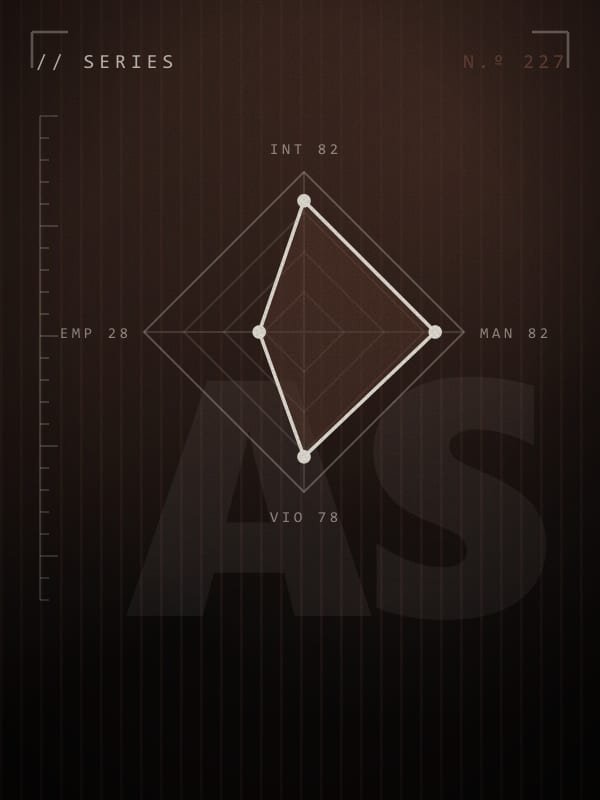
Obito Uchiha, in Naruto, is not born a villain: he is born the kindest of all. He is the clumsy kid who arrives late to training because he stopped to help an old woman, the one who dreams of becoming Hokage so the village will stop scorning him, the one who silently loves his teammate Rin. And yet he ends up as Tobi, the masked man who orchestrates a world ninja war to trap all of humanity in an eternal dream. Between those two Obitos there is no monster that was hidden from the start: there is a succession of layers that pushed him one after another. For Bronfenbrenner's ecological systems theory, Obito is the textbook case—the villain who can only be understood by unfolding, from the inside out, the nested circles that manufactured him.
// The theoryThe circles that push inward
Ecological theory does not look for a single factor behind crime: it proposes a map in which all of them fit. The person sits at the center of nested settings like Russian dolls. The microsystem is the intimate circle (friends, the team, the love for Rin); the mesosystem, how those settings talk to each other; the exosystem, the powers that decide one's fate without consulting them (the village leaders, the military machinery); the macrosystem, the ideology of the era (a shinobi world where children are weapons and war is the natural state); and the chronosystem, the historical moment that made his story possible and not another. Obito travels through all five layers in order. Each one displaces him a little further from the boy he was, and none, on its own, is enough to explain what he became. It is the dialogue among all of them—and not an inner flaw—that produces Tobi.
The hinge: when the micro breaks against the macro
Obito's breaking point is an instant in which two layers collide. In his microsystem there is a promise—to protect Rin, the person he loves—and a rule of his own that he hurls at his teammate Kakashi, under their teacher Minato: those who abandon a comrade are worse than trash. But that microsystem is nested inside a brutal macrosystem: a system of villages in perpetual war that turns Rin into a disposable weapon and drives her to death before his own eyes. In that second, Obito's intimate logic (save the one he loves) crashes head-on into the logic of the world (individuals do not matter, only the village), and the boy concludes that the error is not his: it is reality's. There his ideology is born—if the real world killed Rin, then the real world must be replaced by a dream in which she lives. The theory teaches us to see that hinge: not a heart that turned evil, but a microsystem crushed by the macrosystem that contained it.
// The subjectThe mentor who indoctrinates the wound
No layer operates more visibly on Obito than the mesosystem of a manipulative mentor. Badly wounded and desperate, the boy is taken in by Madara Uchiha, who does not heal the wound: he indoctrinates it. Madara hands him a complete narrative—the "Eye of the Moon Plan", the Infinite Tsukuyomi— that turns Obito's private pain into a cosmic project: a genjutsu that will trap all of humanity in a perfect, suffering-free dream, a world where no one will ever again lose the person they love. It is the classic operation of the radicalizer: take a real wound and offer it an ideology that explains it, dignifies it and arms it. Obito does not choose evil out of nowhere; he receives a prefabricated ideological macrosystem that gives meaning to what had none. Understanding that mechanism—trauma captured by a mentor with a plan—does not erase a gram of his responsibility: every razed village, every death he causes as Tobi, remains his. Explaining the layers illuminates why the trigger reached his hands; it does not take his hand off the trigger.
Obito Uchiha
Get the map of theories for free
Subscribe to the criminal archive —one case a week, no spam— and I'll send you The map of theories: the great currents of criminology on a single sheet.
// The crackNeither pure monster nor leaf blown by the wind
The crack with Obito has two edges. The first is dismissing him as "evil just because", a masked villain with no history—which erases everything his case teaches about how an extremist is really manufactured. The second, its opposite, is subtler: using the layers as an alibi. If it was all the war, Madara and Rin's death, where does that leave Obito? Bronfenbrenner never said that. His model keeps the person as an active pole: the circles push, but the individual responds. And the series itself proves it—another boy from the same shinobi world, raised in the same war, with losses equal or worse, is Naruto, who chooses exactly the opposite. The system explains the odds, it does not dictate the outcome. Two people from the same macrosystem take opposite paths, and that difference is where moral responsibility lives.
That Obito, in the end, repents and dies protecting Naruto does not cancel the war he unleashed, but it closes the circle with ecological precision: the same man could be pushed toward the abyss by his layers and, later, choose to climb out of it. The lesson is not that the layers condemned him beyond remedy, but that they were there at every step—and that in each one of them, had it been different, the story could have bent another way.
Where to intervene so there is no Tobi
Obito matters because his story is a map of intervention points. If evil is manufactured layer by layer, then layer by layer it can be dismantled: a macrosystem that did not treat children as weapons; an exosystem of villages that did not solve everything with war; a mesosystem where, instead of a Madara who captures his wound, there had been an adult to accompany it; a microsystem that did not make him believe that losing Rin was losing everything. Each layer that had been different is a Tobi who would not have existed. That is the ethical usefulness of the ecological model: it does not hand out innocence, it hands out responsibility and prevention. Against the temptation to look for a single culprit (the bad mentor, the bad era, the broken heart), it forces us to look at the whole system and to ask, at every level, what would have been needed. Understanding Obito is not forgiving him: it is knowing where to put our hands so the next story turns out different.
Three key takeaways
- Obito Uchiha is the textbook case of ecological theory: an idealistic, kind-hearted boy turned apocalyptic villain not by an inner flaw, but by the sum of his layers—friends and the love for Rin (micro), the perpetual ninja war (exo/macro), the traumatic death of Rin and the mentor Madara who indoctrinates it (meso/macro).
- His hinge is a collision between layers: the microsystem (save the one he loves) crushed by the macrosystem (a shinobi world that treats individuals as disposable weapons). From there the ideology of the Infinite Tsukuyomi is born, a real trauma captured and armed by a radicalizer with a plan.
- Neither pure monster nor leaf in the wind: Naruto, raised in the same system with equal losses, chooses the opposite. The layers push, the person responds. Understanding the circles that manufactured Obito does not erase his responsibility—it makes it legible, and with that, preventable.
Sources · further reading
- Bronfenbrenner, U. (1979). The Ecology of Human Development: Experiments by Nature and Design. Harvard University Press.
- Bronfenbrenner, U. (1994). “Ecological Models of Human Development”. International Encyclopedia of Education (2.ª ed.), vol. 3. Elsevier.
- Krug, E. G. et al. (eds.) (2002). Informe mundial sobre la violencia y la salud. Organización Mundial de la Salud.
Case-file questionsFrequently asked questions
Who is Obito Uchiha?
Obito Uchiha (“Tobi”) is a villain from Naruto, analysed on KRIMINIS through the lens of criminology. He started out as the kindest of all: a boy who ran late because he stopped to help the elderly and who loved Rin.
Why does Obito Uchiha (Tobi) become a villain?
Obito Uchiha and the nested systems: an idealistic kid who loved a girl and dreamed of protecting his village, shaped layer by layer—friends, war, a manipulative mentor—until he wanted to erase the real world. Remove a single layer and the villain does not exist.
Which criminological theory explains Obito Uchiha?
Obito Uchiha's case is analysed through Human ecological systems. Bronfenbrenner's ecological theory reads the person as the center of nested circles—family and friends, the relationship between settings, the powers that decide without consulting them, culture and era—that shape them from the outside in. Obito Uchiha, from Naruto, is its perfect case: an idealistic, kind-hearted boy (micro), shattered by the perpetual ninja war and by the traumatic death of Rin (exo/macro), and then indoctrinated by Madara with the ideology of the Infinite Tsukuyomi (meso/macro). No layer excuses him; all of them explain him.