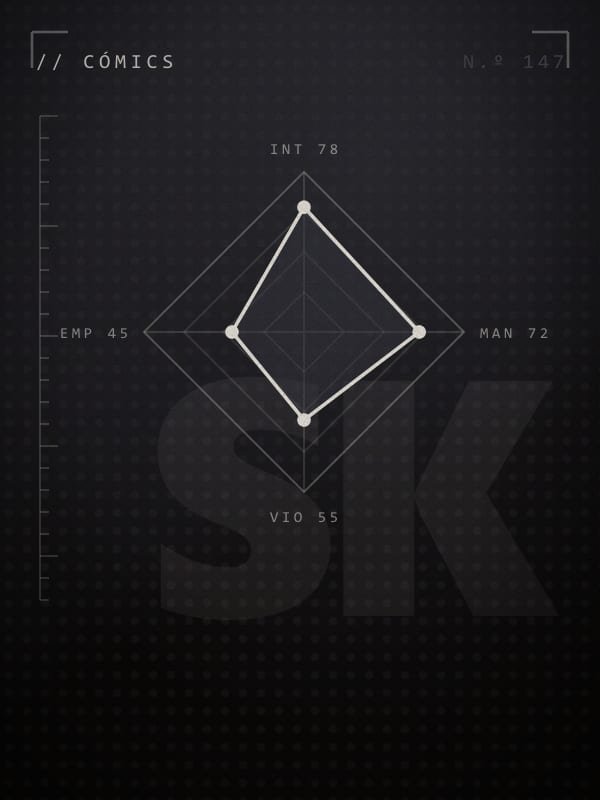
Mr. Compress —Atsuhiro Sako— is the most theatrical villain in My Hero Academia: a tragedy mask, an illusionist's gestures and a power that lets him compress anything into a marble. But behind the spectacle there is a very concrete biography that he himself proudly claims: he is the descendant of a lineage of thieves in the Robin Hood mold, a family that for generations robbed the powerful and told itself it did so for justice. That genealogy is the key. Because Sako's crime is explained not by an evil gene nor by a cost-benefit calculation, but by something far more everyday: he learned it at home. He inherited from his own the techniques, the motives and —most importantly— the justifications. He is differential association made character.
// The theoryCrime is learned, in the family too
In 1939, the sociologist Edwin Sutherland broke the false dilemma between the born criminal and the rational criminal with a third path taken for granted today: criminal behavior is learned, in interaction with other people and above all in intimate groups. His thesis, summed up in nine propositions, has a decisive nuance that Sako illustrates perfectly: what is learned is not only the techniques (how to pick a lock, how to flee without a trace), but also the motives, attitudes and justifications that make crime possible and even admirable. A person offends when the definitions favorable to breaking the law that they have received outweigh the unfavorable ones. "Bad company" is not enough: what decides is the proportion of messages for and against, their intensity and at what age they arrived. And there is no group more intimate, earlier or more intense than the family. Sako did not stumble upon crime on a street corner: he drank it in from the cradle, wrapped in the heroic tale of a saga of thieves who saw themselves as vigilantes.
Learning the trick and learning the excuse
What makes Mr. Compress a textbook case is not his skill, but the complete package he inherited. Sutherland insisted that criminal learning includes two layers: the technique and the moral alibi. Sako masters both. On one hand, the thief's trade —the illusionism, the sleight of hand, the staging that distracts while the theft happens—. On the other, the rationalization that lets him steal without feeling like a criminal: the idea, passed from parents to children, that his family are vigilante thieves who punish the powerful. It is, almost to the letter, the appeal to higher loyalties that Sykes and Matza described among the techniques of neutralization: "I don't steal out of greed, I steal for a code, for my own, for a cause greater than the law". The family legacy taught him not only to steal; it taught him to steal with a clear conscience. And that alibi, as the whole theory stresses, is as transmissible as the sleight of hand.
Get the map of theories for free
Subscribe to the criminal archive —one case a week, no spam— and I'll send you The map of theories: the great currents of criminology on a single sheet.
// The subjectThe heir to a school of crime
Sako's figure condenses Sutherland's central idea: crime as a trade transmitted in the intimacy of a group. His family works exactly like the "school of crime" the theory describes, except the school is the home and the teacher is the lineage. From it he received a triple curriculum: techniques refined over generations, a social role (that of the elegant, theatrical thief with style) and a legitimizing narrative that turns the offense into a noble inheritance. When Sako grandly presents himself as a descendant of vigilantes, he is not improvising an excuse: he is reciting the identity he was taught, the same one his ancestors used to live at peace with what they did. His theatricality, even, is part of what was learned —a mark of family style, the signature of a lineage that understood theft as art—. In the theory's terms, Sako is proof that definitions favorable to breaking the law do not need a street gang: they can arrive in the warm voice of one's own family, wrapped in genealogical pride.
Mr. Compress
// The crackInheriting the trade does not force you to practice it
Here is the limit of the theory, and it is worth saying plainly: to learn is not to be condemned. Differential association explains where Sako's techniques and alibis came from, but it does not absolve him of having used them. The theory itself has known cracks —it does not clarify why two people from the same group end up different, nor does it explain individual differences well—, and those cracks are precisely the margin of freedom. Many children of criminal families break with the legacy; many hear the same justifications and reject them. That Sako was taught to see theft as a noble cause did not strip him of the capacity to look at his acts and decide otherwise. He chose to keep stealing, he chose to join organizations that cause real harm, he chose to keep the alibi alive instead of questioning it. The inheritance gave him the manual; the responsibility for opening it and applying it was his.
And there is a second crack, more subtle, in his own alibi. The "vigilante thief" narrative is an inherited rationalization, not a description of the facts: Sako does not share out what he steals among the weak nor does he fight the powerful: he collaborates with projects that threaten innocents. The Robin Hood rhetoric is, in his case, exactly what Sutherland described: a favorable definition that silences the conscience, not a truth. Explaining how he learned to justify himself does not validate the justification. Here, remembrance is for those who suffer the consequences of those robberies and that violence, not for the elegance with which their author tells himself he acts for a greater good.
Watching the schools of crime —the warm ones too
Mr. Compress matters because he shifts the focus from blood to learning, and with it from fatality to prevention. If crime is inherited like a trade —with its techniques and its excuses—, then the chain can be broken: what is learned can be relearned. That is the hope beating in the whole theory and what made it the intellectual basis of modern rehabilitation. But it also brings an uncomfortable warning: the "schools of crime" do not always look like a dangerous alley. Sometimes they are a proud home, a family tradition, a heroic tale repeated over after-dinner conversation. The most effective favorable definitions are those that arrive with affection and coherence, because no one questions them. Recognizing that does not serve to excuse Sako, but to understand that fighting crime requires looking at the messages a person receives —from whom, with what intensity, from what age— as much as at their acts. And to remember that no inheritance, however elegant its wrapping, cancels the decision about whom you harm.
Three key takeaways
- Mr. Compress (Atsuhiro Sako) embodies differential association (Sutherland): crime is not inherited in the genes, it is learned in the intimacy of the family —techniques, motives and justifications included—.
- His "vigilante thief" narrative in the Robin Hood mold is an inherited favorable definition: a moral alibi, transmissible like the trade itself, that lets him steal without feeling like a criminal.
- To explain is not to excuse: learning a trade and its excuses does not force you to practice it. Sako chose to open the manual he was bequeathed, and remembrance is for those who suffer his robberies, not for the elegance with which he justifies himself.
Sources · further reading
- Sutherland, E. H. (1939). Principles of Criminology. Lippincott.
- Sykes, G. M. & Matza, D. (1957). «Techniques of Neutralization». American Sociological Review, 22(6).
- Akers, R. L. (1973). Deviant Behavior: A Social Learning Approach. Wadsworth.
- Warr, M. (2002). Companions in Crime: The Social Aspects of Criminal Conduct. Cambridge University Press.
Case-file questionsFrequently asked questions
¿Quién es Mr. Compress?
Mr. Compress («Atsuhiro Sako») es un villano de My Hero Academia, analizado en KRIMINIS con la lente de la criminología. He presents himself as the heir to a Robin Hood-style lineage of thieves.
¿Por qué Mr. Compress (Atsuhiro Sako) se convierte en villano?
Mr. Compress and differential association: crime does not run in the blood, it is learned in the intimacy of the family. A descendant of vigilante thieves who inherited the techniques, the motives and, above all, the excuses.
¿Qué teoría criminológica explica a Mr. Compress?
El caso de Mr. Compress se analiza desde la Asociación diferencial. Differential association (Sutherland) holds that crime is neither inherited nor calculated: it is learned in intimate groups, and not only the techniques, but also the motives and the justifications favorable to breaking the law. Mr. Compress (Atsuhiro Sako), of My Hero Academia, is a textbook case: a theatrical villain who claims to be the descendant of a Robin Hood-style lineage of vigilante thieves, from which he received the code, the techniques and the moral alibis. His crime springs not from a defect or a cold calculation, but from a legacy passed down from generation to generation, like teaching a family trade.