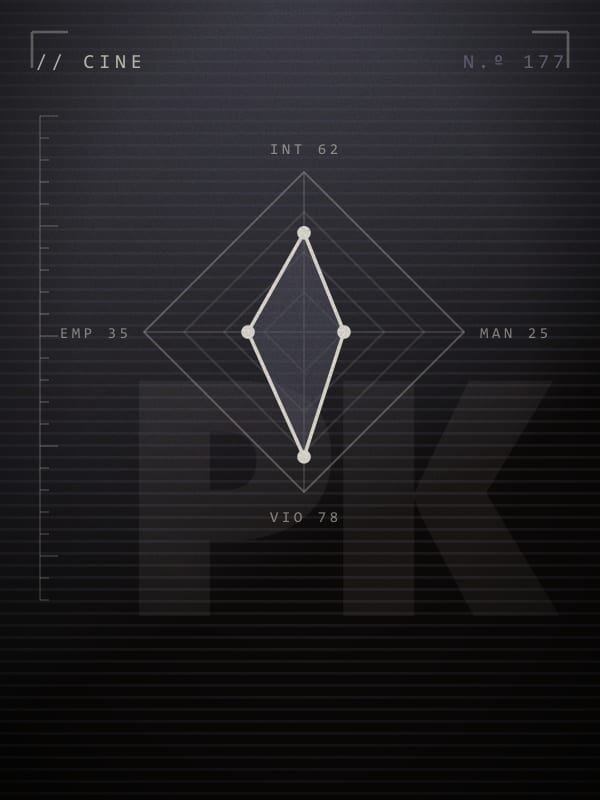
Frankenstein's Creature is not born killing. It is born curious and tender: it learns to speak hidden in a hovel, it reads Paradise Lost, it saves a girl from drowning in a river. What turns it into a murderer is not its brain — it is rejection. Its creator abandons it the moment he lays eyes on it; the villagers beat it; the family it loves with devotion flees in horror. Only then does it swear hatred against the species that spurned it. Two hundred years before a single brain scanner existed, Mary Shelley posed the question that biological criminology still hasn't closed: is the monster born, or made?
// The theoryCrime seen from inside the skull
Neurocriminology is the modern, serious heir to an old idea: that crime has biological roots. Its central figure, Adrian Raine, distilled decades of research in The Anatomy of Violence (2013): using neuroimaging, he found that many murderers and psychopaths show a less active prefrontal cortex (the region of self-control and the braking of impulses) and anomalies in the amygdala (the center of fear and empathy). To this he adds genetic factors, complications during pregnancy, blows to the head, early malnutrition. The thesis: certain brains are, by manufacture or by accident, worse equipped to inhibit violence.
It is neither science fiction nor entirely new. In 1848, an iron rod pierced the skull of Phineas Gage and destroyed part of his frontal lobe: he survived, but the responsible, affable man turned impulsive and disinhibited — the first famous proof that damaging a region of the brain changes moral behavior. Neurocriminology picks up that thread and carries it into the present: scanners in trials, debates over the “warrior gene” (MAOA), prevention programs. Its promise is enormous and so is its shadow, because it touches the most uncomfortable question: if crime lives in the brain, how far does guilt reach?
Biology loads; environment fires
The mature version of neurocriminology—Raine's own—does not say “the brain is destiny”. It says something finer: biology predisposes, it does not compel. A brain with self-control deficits is a risk that an environment of abuse, poverty or neglect can turn into violence, and that an environment of care can defuse. The formula attributed to him sums it up: biology loads the gun; the environment pulls the trigger. The Creature is its perfect illustration, and that is why it is so rich: in the 1931 film it is literally armed with a stolen “criminal brain” (biology); in Shelley's novel it is born a blank slate and rejection programs it (environment). The two versions together are, exactly, the interaction that science defends.
// The subjectThe monster who asked to be treated as human
What makes the Creature an unrepeatable case is that it argues its own case. It is no mute beast: it is eloquent, it educates itself, and it holds Victor Frankenstein to account with disarming logic — “I was benevolent and good; misery made me a fiend”. It asks for one thing only, a companion, someone who will not flee from it; when Victor denies it, revenge is unleashed. Its violence is reactive, not gratuitous: it responds to relentless cruelty. And there lies the character's edge against simple neuro-determinism: if a being is born capable of loving, reading and saving lives, and only kills after years of repudiation, where is the “criminal brain”? The monster did not arrive a monster. It was manufactured, blow by blow, by a world that decided its guilt from its face — the same prejudice as the born criminal, now in reverse.
Frankenstein's Creature
// The other readingThe body that the gaze turned into a monster
A century before neurocriminology, William Sheldon claimed that the physique predicts conduct: the criminal body exists and can be read. The Creature is the thought experiment that disproves it. His body is as "monstrous" as can be imagined, and yet his nature is tender: he learns to speak by listening to a family, is moved by their kindness, secretly helps those he loves, longs for company and affection. If Sheldon's theory were true, that body should harbor a born killer. Shelley shows it harbors, at the start, almost the opposite—and that the killer is manufactured afterward.
The self-fulfilling prophecy of the body
The Creature is the pure example of a self-fulfilling prophecy—the mechanism of labeling applied to the physique—. Society sees a monster, treats him as a monster, and by that treatment turns him into a monster. The body did not contain the evil; the evil was produced by the reaction to the body. It is the exact inversion of Sheldon: it is not that the monstrous physique causes the crime, it is that believing it does—and acting accordingly—ends up provoking it. The theory did not describe a biology; it described a way of treating people that manufactures the very thing it fears.
// The film versionThe broken jar: the 1931 "criminal brain"
The 1931 film added to the myth a scene the novel does not have, and it is pure biological determinism. Doctor Frankenstein sends his assistant, Fritz, to steal a brain. In the laboratory there are two labeled jars: one, a “normal” brain; the other, an “abnormal” brain that—according to the lecture just given—belonged to a criminal. Fritz goes for the normal one, gets frightened, drops the jar and it shatters. With no alternative, he takes the other one and carries it off. Frankenstein implants it without knowing. The Creature, afterward, kills. The explanation for his violence is no longer rejection or loneliness: it is the wrong organ.
The temptation of the brain as destiny
The scene of the broken jar contains a seductive and dangerous idea: absolute biological determinism. The film asserts that a “criminal” brain necessarily produces a criminal, regardless of upbringing, treatment, circumstances or choices. It is neurocriminology reduced to caricature—but a revealing caricature, because it lays bare the risk that lurks in all the real theory of brain damage: the temptation to believe that anatomy is destiny. Serious science rejects it: Adrian Raine's studies show that a risk brain is a probability, not a sentence, and that the environment can switch that vulnerability on or off. The 1931 Creature embodies exactly the error against which good neuroscience warns.
Get the map of theories for free
Subscribe to the criminal archive —one case a week, no spam— and I'll send you The map of theories: the great currents of criminology on a single sheet.
// The crackThe brain is not a sentence
Neurocriminology drags along a danger that the Creature illuminates: becoming the atavism of the 21st century. If Lombroso read crime in the jaw, the naive version of this science would read it in a scanner — and with graver consequences, because it sounds like a laboratory. The problems are serious. Correlation is not causation: did the damaged brain produce the violence, or did a violent life—beatings, drugs, stress—damage the brain? The vast majority of people with those neural markers never commit crimes, so the trait does not condemn. And its forensic use —“his amygdala did it”— opens an abyss over responsibility and brushes against the old eugenic temptation to predict criminals before the crime. Raine himself insists on that minefield: predisposition is not a sentence.
The novel votes clearly in that debate. The Creature is not a defective brain to which things happen: it is a being that society, beginning with its father-creator, treats as a mistake from the very first second. Its story says you can have all the biology in the world against you and still not be a monster — until contempt leaves no other way out. The lesson is not to deny biology (brains matter, and Raine has data), but not to hand it the last word. To reduce someone to their scan is to do to the person what the villagers did to the Creature: condemn it for what can be seen and deny it what it might become.
Prevent without condemning
Neurocriminology can go in two opposite directions, and the choice matters. On its bright side, treating crime as public health: caring for pregnancy, nutrition, childhood trauma, blows to the head — Raine has even studied the effect of omega-3s on behavior— to defuse the risk before it explodes. On its dark side, “pre-crime”: filing brains away, predicting the dangerous, punishing the potential. The Creature demands the first and warns of the second. Its tragedy was not being born with the wrong brain: it was being born into a world that decided, at a glance, that it did not deserve care. A criminology that looks at the brain without forgetting the person prevents monsters; one that looks only at the scan manufactures them.
That is why Frankenstein remains, two centuries later, the best pocket manual on the question crime puts to biology. Mary Shelley had no scanners, but she had something science sometimes lacks: the certainty that a being is not only its body, but also what we do with it. The Creature could have been the “Adam” of a new world and ended up its “fallen angel”, and the difference was not decided by its brain — we decided it. The monster, almost always, is not born. It is made. And in how it is made we play a bigger part than we like to admit.
Three key takeaways
- Neurocriminology (Raine, 2013) links violence to brain deficits—prefrontal cortex, amygdala—of genetic, prenatal or injury-based origin (the case of Phineas Gage). The Creature stages the debate: an “abnormal” brain (film) versus rejection (novel).
- The serious version is not deterministic: biology loads the gun, the environment pulls the trigger. The Creature is born capable of loving and only kills after years of repudiation — reactive violence, not a factory-made “criminal brain”.
- The crack: neuro-determinism is the atavism of the 21st century—correlation ≠ causation, almost no one with those markers commits crimes, and forensic use brushes against “pre-crime”—. Used well, it prevents like public health; used badly, it condemns by a scan.
Sources · further reading
- Sheldon, W. H. (1949). Varieties of Delinquent Youth. Harper & Brothers.
- Gould, S. J. (1981). The Mismeasure of Man. Norton.
- Raine, A. (2013). The Anatomy of Violence: The Biological Roots of Crime. Pantheon.
- Raine, A. et al. (1997). “Brain Abnormalities in Murderers Indicated by Positron Emission Tomography”. Biological Psychiatry, 42(6).
- Damasio, H. et al. (1994). “The Return of Phineas Gage: Clues About the Brain from the Skull of a Famous Patient”. Science, 264.
- Shelley, M. (1818). Frankenstein; or, The Modern Prometheus. Lackington, Hughes, Harding, Mavor & Jones.
Case-file questionsFrequently asked questions
Who is La Criatura?
La Criatura (“el monstruo de Frankenstein”) is a villain from Frankenstein, analysed on KRIMINIS through the lens of criminology. Frankenstein's Creature is born good.
Why does Frankenstein's Creature become a villain?
Frankenstein and neurocriminology: does violence lie in a defective brain, or in a world that manufactures monsters through rejection? Mary Shelley's Creature lays on the table—two hundred years before the scanners—the question the science of crime still hasn't closed.
Which criminological theory explains La Criatura?
La Criatura's case is analysed through Neurocriminology. Neurocriminology holds that certain brain deficits—in the prefrontal cortex, the amygdala—predispose to violence, with genetic and prenatal roots. Mary Shelley's Creature stages the exact debate that science inhabits: in the novel it is born innocent and rejection makes it a monster (environment); in classic film it is armed with an “abnormal” criminal brain (biology). The honest answer of the neuroscience of crime is neither one nor the other, but their interaction: biology loads the gun; the environment pulls the trigger.