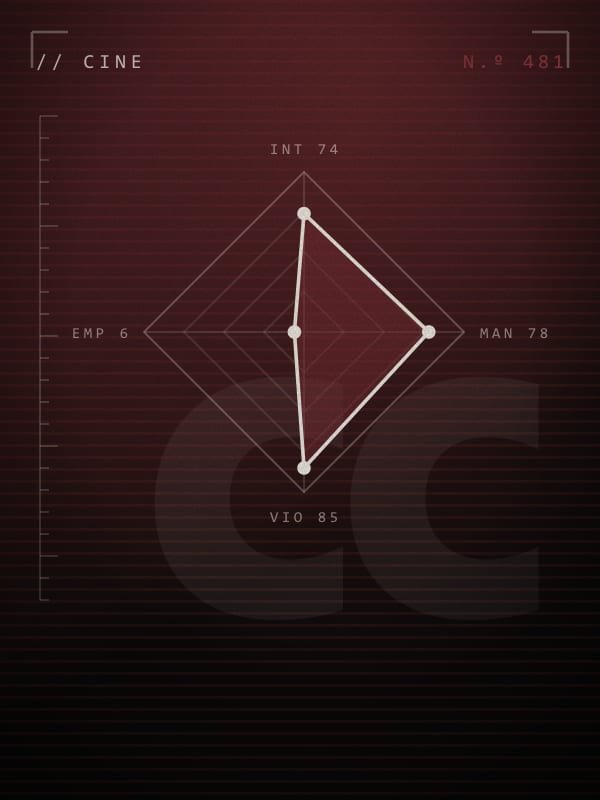
The Tall Man is the imposing, spectral villain of Phantasm (Don Coscarelli, 1979) and its sequels: an undertaker who rules a mausoleum from which he steals corpses, reanimates them as dwarf slaves, and sends them to another dimension. His realm is a very concrete and very deliberately chosen space: the cemetery and the funeral home, the territory of the dead. For the theory of defensible space, no villain embodies the idea of the indefensible space with such purity: a place where, by definition, there are no living eyes to watch, no community to claim it as its own, and no one who returns to tell what happens there.
// The theoryThe space no one claims
Newman’s four keys —territoriality, natural surveillance, image and milieu— describe what makes a space defensible. The nocturnal cemetery cancels all four at once. Territoriality: it is the land of the dead, who cannot claim it; no living neighbor feels it is «theirs» or defends it. Natural surveillance: there are no inhabited windows, no passersby, no «eyes on the street» —only blind headstones and darkness—. Image: it is, literally, a place of abandonment and of endings, charged with the silence that signals that no one is looking there. And its milieu is usually the edge of the city, remote and solitary. The Tall Man did not choose his domain by accident: he chose the one territory in the whole of human geography that combines, at once, the total absence of owner, of gaze and of witnesses. It is the perfect laboratory of crime because it is the perfectly indefensible space.
No witnesses who return
The Tall Man illustrates the most extreme trait of the indefensible space: it not only lacks witnesses during the crime, it prevents witnesses from existing afterward. Newman’s natural surveillance works because the gaze leaves a trace: someone saw, someone can tell it, someone can report it. The Tall Man’s cemetery cancels that chain at both ends —no one watches while it happens, and no one returns to narrate it—. His victims not only die unseen; they are recruited into his army of slaves, absorbed by the space itself, erased from the world of the living. The theory teaches why the territory of the dead is the archetype of the dangerous place across the whole imaginary of horror: because it concentrates the total absence of surveillance with the impossibility of return. A space becomes truly indefensible not only when no one watches, but when no one who enters can leave to tell what they saw —and the cemetery, in fiction, is the name of that place of no return—.
Get the map of theories for free
Subscribe to the criminal archive —one case a week, no spam— and I'll send you The map of theories: the great currents of criminology on a single sheet.
// The subjectThe owner of what no one wants
What is cunning about the Tall Man as a figure is that he has installed himself in the one space that the society of the living abandons voluntarily. No one disputes the cemetery; no one spends the night there for pleasure; no one watches over the dead. By appropriating that void, the villain becomes the absolute sovereign of a territory that no one else wants —and, therefore, that no one else defends—. It is the spatial lesson of Gothic horror taken to the extreme: evil takes root in the places that the community of the living has stopped looking at. Crypt, mausoleum, morgue, tomb: these are the corners where natural surveillance withdraws out of respect, out of fear or out of decorum, and it is that withdrawal that the predator exploits. The Tall Man does not cause the cemetery’s defenselessness —society serves it up to him on a platter by deserting it—; he merely occupies the gap the living leave him.
El Hombre Alto
// The riftThe spaces of death cannot be "lit up"
The rift the Tall Man reveals is an honest limit of the theory of defensible space. Newman could light a street, open sightlines or close off an alley; but there are spaces whose defenselessness is constitutive and cannot be corrected with design. The cemetery will always be a territory without living inhabitants, without permanent eyes, charged with the silence of death —you cannot put a neighborhood shop there or neighbors who lean out from their balconies—. The theory, so powerful in the everyday urban space, finds its frontier here: certain places (the cemetery, the deep forest, the open sea, the deserted road) are indefensible by nature, not by bad design. Recognizing this avoids the naive determinism of believing that every space can be redesigned toward safety. Some places will keep belonging, in the imaginary and sometimes in reality, to whatever lurks in the shadow —and the only possible defense against them is not to venture in alone—.
That the villain of Phantasm is a gravedigger —the trade society delegates so as not to look at its own dead— is the irony the saga sets against the theory: we have handed over the most indefensible territory of all, that of death, to a space we prefer not to watch, and in that gap of our gaze is where terror sets up its throne.
Watch over the spaces we abandon too
The Tall Man matters because he points to the spaces that design theory cannot rescue, but that the community should not entirely forget. The practical lesson is not that the cemetery can become a safe square —it cannot—, but that every space that society abandons completely becomes no-man’s-land, and no-man’s-land is always the predator’s land. It holds for the cemetery of fiction and for its real equivalents: the vacant lot on the outskirts, the ruined building, the deserted underground parking garage, the unwatched stretch of road. Every time a community completely deserts a space —stops looking at it, caring for it, claiming it—, it creates a void that something or someone will occupy. Defensible space teaches that safety is not built with walls and cameras alone, but with presence: with a community’s refusal to abandon its own dark corners entirely to silence and to shadow.
Three key takeaways
- The Tall Man, the villain of Phantasm, reigns over the most indefensible space imaginable: the cemetery and the funeral home, the territory of the dead with no living eyes, no owner to claim it, and from which no one returns.
- He cancels Newman’s four keys at once —no territoriality, no natural surveillance, an image of pure abandonment and a remote milieu— and adds the extreme trait of the space of no return: no one watches while it happens and no one comes back to tell it.
- He reveals an honest limit of the theory: there are spaces (cemetery, forest, deserted road) that are indefensible by nature, not by bad design. The lesson: every space the community abandons completely becomes no-man’s-land —and the predator’s.
Sources · further reading
- Newman, O. (1972). Defensible Space. Macmillan.
- Jacobs, J. (1961). Muerte y vida de las grandes ciudades. Random House.
- Lovejoy, B. (2013). Rest in Pieces. Simon & Schuster.
Case-file questionsFrequently asked questions
¿Quién es El Hombre Alto?
El Hombre Alto («The Tall Man») es un villano de Phantasm, analizado en KRIMINIS con la lente de la criminología. A cemetery at night.
¿Por qué El Hombre Alto (The Tall Man) se convierte en villano?
The Tall Man and defensible space: the villain who reigns over the most indefensible place imaginable —the cemetery, the funeral home—, a territory of the dead where no one watches and from which no one returns.
¿Qué teoría criminológica explica a El Hombre Alto?
El caso de El Hombre Alto se analiza desde la Espacio Defendible. The theory of defensible space (Newman) shows that crime thrives where territoriality, surveillance and an image of care are absent. The Tall Man, the villain of Phantasm, reigns over the most indefensible space that exists: the cemetery and the funeral home, a territory of the dead with no living eyes, no owner to claim it, and from which no one returns to tell what they saw.