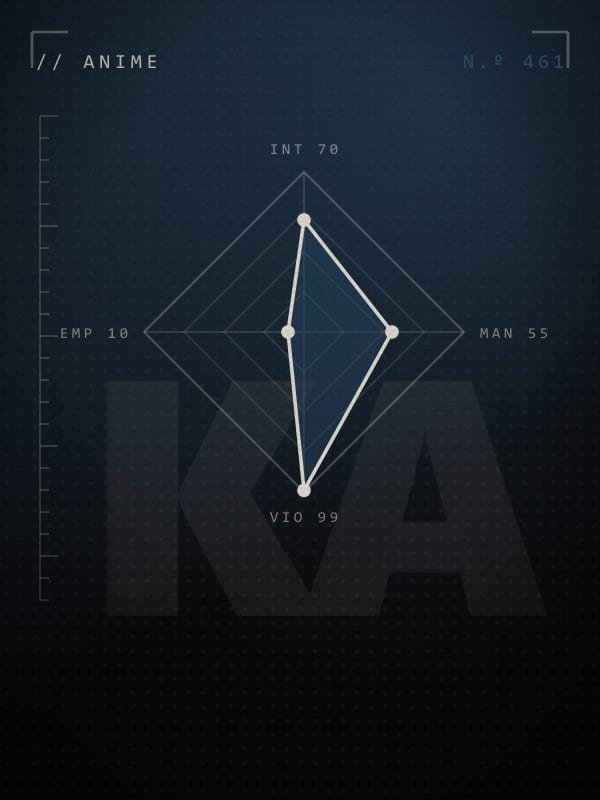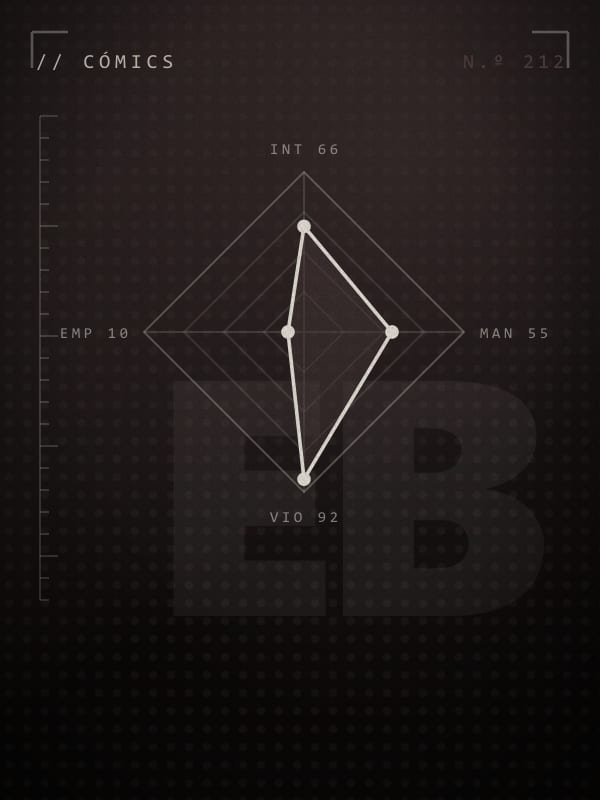
Charlotte Linlin, whom the world fears as Big Mom, is one of the four Emperors who reign over the second half of the Grand Line in One Piece. She rules Totto Land, an archipelago of mixed races where giants, dwarves, fish-men and humans live together under her flag. On paper, her dream is beautiful: a world without racial borders, a great table where no one is scorned for what they are. In practice, that dream rests on terror —and on a temperament that can swing from laughter to slaughter in a second—. When Big Mom is seized by a craving, a sudden and irresistible desire for a particular sweet, she stops ruling and starts razing: she wrecks her own castle, crushes her subjects, ignores her children, until she gets what she wants. For the low self-control theory, that character is no writer's eccentricity: it is the clinical portrait of a single idea —crime is committed by those who cannot wait—.
// The theoryA single cause: not knowing how to wait
In 1990, Michael Gottfredson and Travis Hirschi published A General Theory of Crime with a thesis as simple as it was provocative: there are not a thousand causes of crime, there is one. Low self-control, the inability to resist immediate, easy and exciting gratification, even when in the long run it costs a fortune. They described it through several traits that tend to go together: impulsivity, a preference for the immediate over the deferred, low tolerance for frustration, a short temper, thrill-seeking and self-centeredness. And they argued something decisive: that brake —or its absence— is forged before the age of ten, in an upbringing that watches, detects and corrects; afterward, it barely changes. Big Mom embodies every box on that list with an almost didactic clarity. She does not calculate the cost of her outbursts, nor does she learn from them: she gives in to the impulse of the moment because the brake, quite simply, was never installed. Her cravings are the marshmallow test turned catastrophe: she wants the sweet, she wants it now, and the whole world can burn as long as she does not have it in her mouth.
It's not that she can't calculate: it's that she can't wait
The theory distinguishes the rational offender, who weighs costs and benefits, from the one who lacks an inner brake: this one makes no calculation at all, giving in to the temptation of the instant. Big Mom illustrates it in its purest form. She lacks neither power nor strategic intelligence —she runs a pirate nation—, she lacks the capacity to postpone gratification. When the craving appears, no future consequence weighs enough: not losing allies, not humiliating her children, not sabotaging her own plans. Immediate gratification always wins because the mechanism that should curb it was never assembled. And since that mechanism, according to Gottfredson and Hirschi, is bred in childhood, the key to a character like this lies not in her adult crimes, but much earlier: in the girl who never learned that waiting was worth it. That is why the theory insists that the lever of prevention is not later punishment, but teaching how to wait in time.
Get the map of theories for free
Subscribe to the criminal archive —one case a week, no spam— and I'll send you The map of theories: the great currents of criminology on a single sheet.
// The subjectThe girl who never learned to brake
What makes Big Mom a textbook case is not just her adult conduct, but her origin. The low self-control theory is, above all, a theory of early development, and Linlin's story follows it to the letter. As a child she was already a colossal force, physically incapable of measuring her own power, raised in an environment that never set effective limits on her —cared for by those who feared her more than they corrected her—. Her first episodes of uncontrollable craving ended in disappearances and destruction that no one dared to stop, and that impunity sealed the pattern: immediate gratification always won, and there was never a cost to teach her to wait. The result is exactly what the theory predicts: a stable trait, forged in childhood, that accompanies her unchanged to the summit of power. The difference from any other case is one of scale: where another child without a brake breaks a toy, Linlin razes a village; where another adult without a brake loses a job, the Empress loses fleets, children and allies. The same old low self-control, multiplied by the power of an entire country. The low tolerance for frustration —those tantrums that disconnect her from everything else— is not a decorative flourish of the character: it is the engine of nearly all her crimes.
Big Mom
// The crackThe cravings… and the calculation that's too much
The crack with Big Mom is that it is not only impulse. The low self-control theory predicts someone who does not plan, who does not defer, who does not build for the long term —and Linlin, between one craving and the next, does exactly the opposite—. Over decades she weaves a network of calculated marriage alliances, administers a commercial empire, and hatches a meticulous ambush at a wedding to eliminate a rival. That strategic calculation, that capacity to postpone a goal for years, contradicts the idea of a self-control that is totally absent. Here one of the classic criticisms of the theory surfaces (formulated by Akers): its circularity and its excess of ambition. If we explain crime by impulsivity, what do we do with the criminal who also plans? Pratt and Cullen's own meta-analysis concluded that self-control is one of the best predictors of crime, but not the only one: reducing everything to a single cause, as the book's title promised, turned out to be an overstatement. Big Mom is not pure impulsivity; she is impulsivity and strategy, two things that a single-cause theory struggles to sustain at once.
And there is a second crack, the usual one: to explain is not to excuse. Understanding that Linlin was never given a brake in childhood helps to grasp the mechanism of her outbursts, not to forgive them. A craving explains why she erupts; it does not erase those she crushes when she erupts. The low self-control theory, read properly, offers no alibis: it describes how a trait is forged so it can be prevented in time, not to absolve the adult who drags it along of responsibility. Big Mom chose to build her kingdom on fear, and she answers for every island that fear razed. The memory that matters is not that of the Empress and her cravings, but that of all those who ended up beneath her feet when the sweet she wanted did not arrive in time.
Raise the brake, before it razes an island
Big Mom matters because she takes to the extreme an idea with enormous practical consequences. If self-control is forged early and then barely changes, the best policy is not to wait for the adult monster in order to punish it, but to invest in childhood —upbringing, limits, environments that teach how to delay gratification and tolerate frustration—. Linlin's story is the fable of the opposite: a girl of colossal power whom no one knew how, or dared, to rein in, and who grew up into a catastrophe with a crown. The trap, the theory itself warns in its honest version, is to use it to simply blame families, forgetting that the reliability of the environment —that promises are kept, that waiting is sometimes worth it— makes it far easier to install that brake. Teaching how to wait is simpler where the world is predictable. And an entire island may depend on someone, in time, teaching a child to say «not yet».
Three key takeaways
- Big Mom (Charlotte Linlin) embodies the low self-control theory (Gottfredson and Hirschi, 1990): her uncontrollable cravings and tantrums are the inability to postpone gratification taken to the extreme, with the power of a country behind it.
- The theory is one of early development, and her origin confirms it: a childhood without effective limits never installed the brake, and the trait stayed stable up to the summit of power. The same old low self-control, multiplied by scale.
- The crack: her strategic calculation —alliances, ambushes, an empire— contradicts total low self-control, and reminds us that self-control predicts a lot, but is not the only cause (Pratt and Cullen). Explaining the craving does not excuse the one who razes.
Sources · further reading
- Gottfredson, M. R. & Hirschi, T. (1990). A General Theory of Crime. Stanford University Press.
- Akers, R. L. (1991). «Self-Control as a General Theory of Crime». Journal of Quantitative Criminology, 7(2).
- Pratt, T. C. & Cullen, F. T. (2000). «The Empirical Status of Gottfredson and Hirschi’s General Theory of Crime: A Meta-Analysis». Criminology, 38(3).
- Moffitt, T. E. y cols. (2011). «A Gradient of Childhood Self-Control Predicts Health, Wealth, and Public Safety». PNAS, 108(7).
Case-file questionsFrequently asked questions
¿Quién es Big Mom?
Big Mom («Charlotte Linlin») es un villano de One Piece, analizado en KRIMINIS con la lente de la criminología. She dreams of a kingdom where every race lives together in peace.
¿Por qué Big Mom (Charlotte Linlin) se convierte en villano?
Big Mom and the low self-control theory: how a craving can level an island. Impulsivity as the sole cause of crime, forged in childhood and armed with unlimited power.
¿Qué teoría criminológica explica a Big Mom?
El caso de Big Mom se analiza desde la Bajo autocontrol. The low self-control theory (Gottfredson and Hirschi, 1990) reduces crime to a single cause: the inability to resist immediate gratification, a brake that is forged in childhood and barely changes afterward. Big Mom (Charlotte Linlin), from One Piece, is that idea taken to the extreme: a pirate empress with the power of an entire country and the self-control of a child mid-tantrum. Her uncontrollable cravings drive her to destroy anything in her path —her own family included—, and her story begins precisely in a childhood without limits that never installed the brake. Pure impulsivity with unlimited power.