For most of us, danger speeds up the heart, makes the palm sweat, warns us. It is the body's alarm system, and we learn to avoid crime partly because the fear of consequences activates us before we act. But some people's bodies are, so to speak, switched off: their heart beats slowly, their alarm barely sounds, and the world reaches them muffled. The hypoarousal theory holds that this low level of activation is one of the most solid biological roots of antisocial behavior.
Hypoarousal at a glance
- Authors
- Hans Eysenck · Adrian Raine
- Year / era
- Eysenck (1960s); consolidated by Raine from 1990
- Family
- Biological · Biosocial
- Idea
- An under-activated body —slow heart, little alarm— lowers the internal brakes against crime
Low arousal → sensation seeking + fear deficit → fewer brakes against crime// OriginThe body that does not sound the alarm
The idea begins with Hans Eysenck, who in the 1960s tied personality to biology: extraverts, he said, have a chronically under-activated nervous system, and that is why they seek constant stimulation to reach a level of arousal that comes to the rest of us on its own. Criminology picked up the finding and refined it with hard data. The most compelling contribution came from Adrian Raine: low resting heart rate is one of the best known biological predictors of antisocial and violent behavior —so reliable that it is measured in children—. A heart that beats slowly at rest is an unreactive body; and an unreactive body has fewer internal brakes against crime.
Why does low arousal push toward crime? The theory proposes two paths that sometimes combine. The first is sensation seeking: someone who lives switched off needs extreme doses of stimulation to feel anything —speed, risk, violence—, and crime offers the rush that others find in a sport or a roller coaster. The second is the fear deficit: if danger does not alarm you, you do not learn to fear punishment. Fear conditioning —the mechanism by which a child internalizes "this brings bad consequences"— fails in the unreactive body. Little fear today means little conscience tomorrow.
Low heart rate: the biomarker
The most cited and most uncomfortable fact of the theory is simple to measure: resting heart rate. The longitudinal studies of Raine and others show that children with the slowest hearts at rest are, as adults, more likely to show violent behavior —even controlling for environment—. It is not that a slow heart "causes" crime (many athletes and monks have one and do not offend), but that it reflects an unreactive body which, combined with other factors, lowers the internal brakes: less fear of risk, more need for stimulation. It is one of the few crime biomarkers that withstands replication —and precisely for that reason it must be handled with enormous ethical caution—.
From the switched-off body to crime, step by step
- 1Baseline low arousalChronically under-activated nervous system: slow heart at rest, muffled alarm
- 2Two divergent pathsSensation seeking (needs extreme stimulation to feel anything) and fear deficit (danger does not alarm)
- 3Weak internal brakesWithout fear of punishment, the "this brings bad consequences" conditioning fails; crime offers the rush others find in sport
- 4The environment sets the targetWith legitimate opportunities it produces a pilot or a surgeon; in an adverse environment, a criminal
Raine's biosocial model: biology loads a predisposition, but the environment decides where it discharges.
// In fictionFive switched-off bodies
Fiction portrays the two faces of hypoarousal. Brandon, in Rope, is sensation seeking in its coldest, most intellectual form: he murders a friend for the pure thrill of committing "the perfect crime" and feeling the excitement of keeping the body in a chest while throwing a party on top of it; danger is his drug. Bodhi is his life-loving flip side: a bank robber who steals not for money but for the rush —he surfs giant waves and jumps without a parachute for the same reason he robs—; for him, "fear is the only thing that makes you feel alive," the sensation-seeker's motto. And Paul, in Funny Games, is hypoarousal as deadly boredom: two young men who torture a family for sheer play, because nothing else stirs any emotion in them anymore.
The other two show the face of the fear deficit. el Cazajudíos, in Inglourious Basterds, is the imperturbable calm of one who feels no alarm: he interrogates, threatens and kills with the serenity of someone having a coffee, enjoying the game without his pulse ever quickening —the switched-off body that turns the absence of fear into a chilling advantage—. And John Doe, in Se7en, is the fanatic of absolute cold blood: he plans atrocities for years with total impassivity, without fear of death or pain, as if his internal alarm had switched off long ago. Sensation seeking or absence of fear: in all five, one and the same body that does not sound the alarm.




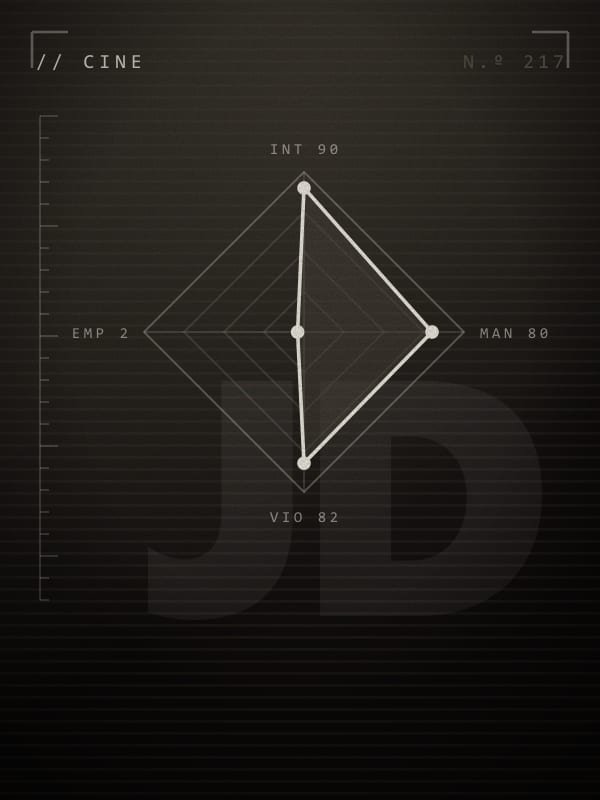
From sensation seeking to cold blood: five switched-off bodies. Tap to open their case file.
// BiosocialBiology is not enough
The most important lesson of the theory is the one its sensationalist versions forget: hypoarousal, on its own, does not manufacture criminals. The vast majority of people with low arousal —many fighter pilots, surgeons, extreme-sport athletes, explorers— channel that need for stimulation and that absence of fear through legitimate, even admirable, paths. The very trait that in an adverse environment pushes toward crime produces, in an environment with opportunities, a firefighter, a Formula 1 driver or a surgeon whose hand does not shake. It is Raine's biosocial model applied to this case: biology loads a predisposition (need for stimulation, little fear), but it is the environment that decides whether that predisposition discharges into a rescue or a robbery.
That is why the phrase that sums up the theory —"kills the way others go skydiving"— is double-edged: it points out that the impulse may be the same, but that the target is set by life, not by the genes. Bodhi robs banks; with another script, he would be the best lifeguard on the beach. The difference between the sensation-seeking criminal and the action hero is not always in the body; it is in what life offered to calm it.
// The crackNeither biological destiny nor an alibi in the pulse
The theory carries two serious dangers. The first is determinism: reading "low heart rate" as "criminal in the making" and sliding toward the old dream of detecting offenders by their biology —Lombroso's ghost with an electrocardiogram—. Science refutes it: it is a probabilistic risk factor, not a destiny, and using it to label children would be as unjust as it is dangerous. The second danger is the alibi: "my switched-off body forced me." No. Having low arousal explains a tendency, it does not eliminate the decision. Landa and John Doe plan their crimes in cold blood; their lack of fear makes them more dangerous, not less responsible. Explaining the pulse does not excuse the act.
Caution counts double here because hypoarousal is measurable, and everything measurable tempts prophecy. The theory is useful for prevention —identifying a child who needs more stimulation and giving it through good channels—, not for condemning anyone by their electrocardiogram.
From Eysenck's temperament to Raine's biomarker
Hypoarousal is one of the biological lines that survived the discredit of Lombrosian positivism because it knew how to be measured. Eysenck anchored it in a theory of personality; Adrian Raine turned it into one of the most replicated findings in neurocriminology, and the Portnoy and Farrington meta-analysis (2015) confirmed that low heart rate robustly predicts antisocial behavior. Its history is also an ethical warning: because it is such a tangible fact, it is the one that most tempts prophecy and the ghost of detecting offenders by their biology.
- 1964–77Eysenck ties personality to biology: extraverts have chronically low arousal.
- 1993Raine publishes The Psychopathology of Crime and places low HR as a central predictor.
- 2013Raine popularizes the biosocial model in The Anatomy of Violence.
- 2015The Portnoy and Farrington meta-analysis confirms the robustness of the low-HR–antisocial-behavior link.
// Why it mattersGiving legitimate stimulation to those who need it
The practical reading of hypoarousal is surprisingly hopeful. If some people offend because their switched-off body needs stimulation and does not fear punishment, then prevention is not more punishment (which scares them little), but offering legitimate stimulation: extreme sport, challenges, intense activities that satisfy the need for sensation through channels that do no harm. The programs that work with sensation-seeking youth do not repress them, they redirect them —they give them the roller coaster their biology asks for—. Raine has even shown that early interventions (better nutrition, exercise, enrichment) modify that physiology. The switched-off body is not a sentence; it is a need that, well attended to, can produce an action hero instead of a criminal.
The hypoarousal theory leaves us, at bottom, with a humble image: that part of what we call evil may begin in something as physical as a heart that beats slowly and a fear that never arrives. It does not excuse it —responsibility remains whole—, but it changes the question: instead of "how do we punish it?", "what did this body need to feel, and why did it not find another way to feel it?".
Lights and shadows
- It rests on one of the few crime biomarkers that withstands replication: low resting HR, measurable and confirmed by meta-analysis.
- It offers a plausible, twofold mechanism —sensation seeking and fear deficit— that connects physiology, learning and behavior.
- It is a biosocial model, not a deterministic one: the same trait produces a criminal or an action hero depending on the environment.
- It has a preventive and hopeful reading: give legitimate stimulation, and Raine's early interventions (nutrition, exercise) modify the physiology.
- High risk of determinism: reading "low HR" as "criminal in the making" revives Lombroso's ghost, now with an electrocardiogram.
- The correlation is modest and probabilistic: many athletes and monks have slow hearts and do not offend; it cannot individualize.
- Because it is measurable, it tempts prophecy and the early labeling of children, with enormous ethical problems.
- It mostly explains violent or impulsive crime tied to arousal; it leaves out white-collar crime, planned and of purely rational motivation.
Three key takeaways
- Hypoarousal (Eysenck, Raine): an under-activated body —low heart rate, little alarm— lowers the brakes against crime through two paths: sensation seeking and the fear deficit (poor conditioning).
- Low resting heart rate is one of the best crime biomarkers, but it is not destiny: the same trait produces a criminal or a fighter pilot depending on the environment (biosocial model).
- Its dangers: determinism (labeling by the pulse, Lombroso's ghost) and the alibi (it does not excuse: the lack of fear makes one more dangerous, not less responsible). To prevent is to give legitimate stimulation, not more punishment.
Sources · further reading
- Eysenck, H. J. (1977). Crime and Personality. Routledge.
- Raine, A. (1993). The Psychopathology of Crime. Academic Press.
- Raine, A. (2013). The Anatomy of Violence. Pantheon.
- Portnoy, J. & Farrington, D. P. (2015). «Resting Heart Rate and Antisocial Behavior: An Updated Systematic Review and Meta-Analysis». Aggression and Violent Behavior, 22.