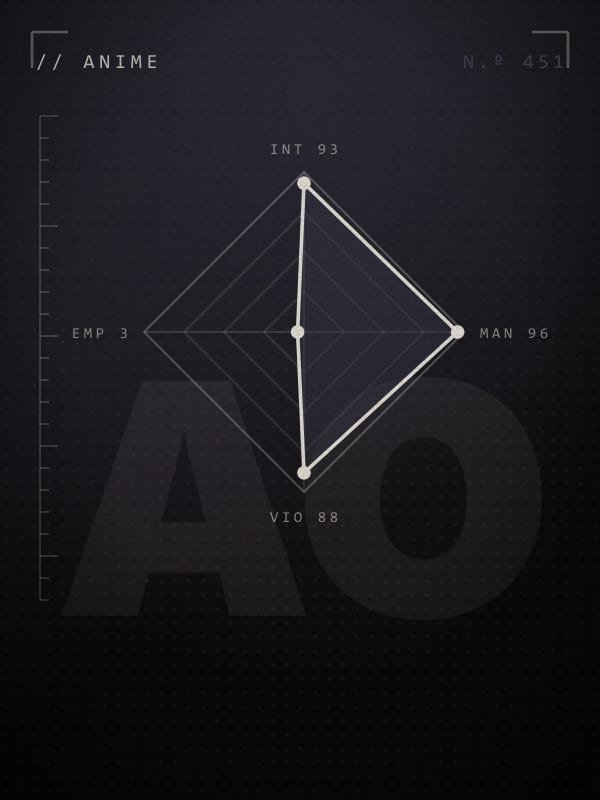
Muscular, one of the most brutal villains in My Hero Academia, does not fit the mold of the calculating criminal. He does not want to rule, he hatches no plans, he seeks no money. What he wants is to fight —and the more extreme the fight, the better—. He kills without guilt, laughs in the middle of combat, grows stronger before a rival who hurts him, and is bored to death when there is no one to tear apart. For the theory of underarousal, this profile is not a screenwriter's whim: it is the portrait of a body that lives dulled from within and only lights up with extreme doses of stimulation. Muscular is the sensation-seeker taken to his most lethal form —someone who only feels alive when the danger is at its peak—.
// The theoryThe dulled body that needs danger
The idea begins with Hans Eysenck, who in the 1960s tied personality to biology: there are chronically underactivated nervous systems, bodies that receive the world muffled and need intense stimulation to reach the level of arousal that comes to the rest of us on its own. Criminology sharpened it with hard data through Adrian Raine, who placed a low resting heart rate among the best known biological predictors of violent behavior —a heart that beats slowly at rest reflects a body with little reactivity, with fewer internal brakes against crime—. The theory proposes two paths that often combine. The first is sensation-seeking: someone who lives dulled needs speed, risk, or violence to feel something, and crime offers the rush others find in an extreme sport. The second is the fear deficit: if danger does not alarm you, you do not learn to fear punishment, and the conditioning that teaches "this brings bad consequences" fails. Muscular brings both paths together with an almost textbook clarity. You can read the full theory in the underarousal file.
Violence as the only rush
What defines Muscular is not hatred, but the underlying boredom. Nothing thrills him anymore except combat to the death: the more resistance he meets, the more he enjoys it; the more damage he takes, the more he lights up. He is the portrait of the sensation-seeker described by Eysenck —a body so unreactive that only extreme violence can arouse it—. Where another villain kills as a means to an end, Muscular kills because blood is the end: the only experience that pierces his apathy. His dulled body seeks neither power nor revenge; it seeks the rush that makes him feel, for an instant, that he is alive. That is why he fights impossible rivals and laughs when wounded: for him, maximum danger is the minimum dose required. It is sensation-seeking turned into a way of life, and his target is always the most intense one he can find.
Get the map of theories for free
Subscribe to the criminal archive —one case a week, no spam— and I'll send you The map of theories: the great currents of criminology on a single sheet.
// The subjectThe addict to violence without brakes
To sensation-seeking, Muscular adds the other face of the theory: the absence of fear. He does not fear pain —he savors it—, he does not fear defeat, he does not fear punishment. And there lies what makes him so dangerous: the brake that stops most of us before we act, the racing pulse that warns "this could go wrong," simply does not fire in him. Without that alarm system, no calculation of consequences holds him back; he throws himself into every battle with a total commitment that would be suicidal in anyone with a normal body. Fiction paints him as pure destructive instinct, but the theory of underarousal gives it a mechanism: a fear deficit that shuts off the learning of punishment and a need for stimulation that only violence satisfies. It is not that Muscular decides to ignore risk; it is that risk does not speak the same language to him as it does to others. His lack of guilt is not calculating coldness, like that of a planning psychopath; it is the disinhibition of someone who never felt the alarm that teaches us to fear.
Muscular
// The crackExplaining the pulse does not excuse the act
The crack with Muscular is the same one that threatens the whole theory, on its two edges. The first is determinism: reading "underactivated body" as "inevitable criminal" and sliding toward the old dream of detecting delinquents by their biology —the ghost of Lombroso with an electrocardiogram—. Science refutes it: low arousal is a probabilistic risk factor, not a destiny. The same trait that in Muscular discharges into massacres produces, in another life, a fighter pilot, a firefighter, or an extreme-sports athlete who needs adrenaline and does not fear danger. Biology loads the predisposition —the need for stimulation, the absence of fear—, but it is the environment, the life, and the decisions that set the target. Muscular does not kill because he has a dulled body; he kills because he chose, again and again, to satisfy that need in the only form that amused him: destroying others.
The second edge is the alibi: "my biology forced me." No. That underarousal explains a tendency to seek sensations and not to fear punishment does not eliminate the decision to turn that tendency into murder. The lack of fear makes Muscular more dangerous, not less responsible: every victim of his was a choice, not a reflex. Explaining the pulse does not excuse the act. The honest reading holds both things at once —that there may be a physiological root in his craving for violence, and that the responsibility for what he did with it remains entirely his—. The remembrance, here, is not for the villain who laughed in combat, but for all those he turned into the stimulation his dulled body demanded.
The need to feel, misdirected
Muscular matters because he displays, in its most extreme version, something the theory of underarousal applies to the real world: there are people whose body asks for an intensity that ordinary life does not give them, and almost everything depends on what they do with that need. The same engine that pushes a sensation-seeker toward violence can push him toward a mountain rescue, the emergency room, or the racetrack. That is why the preventive reading of the theory is not more punishment —which frightens little someone who does not fear—, but offering legitimate stimulation: channeling the need for sensations through paths that do no harm. Muscular is what happens when that need finds no outlet other than blood. It does not excuse him; but it changes the question we ask him: instead of "how monstrous was he?", "what did this body need to feel, and why did it only know how to seek it by destroying?".
Three key takeaways
- Muscular embodies the theory of underarousal (Eysenck, Raine): a chronically underactivated body that only reaches arousal in extreme violence. He kills for the rush, not for an end —he is the sensation-seeker in his most lethal form—.
- He combines the theory's two paths: sensation-seeking (he needs combat to the death to feel something) and the fear deficit (he fears neither pain nor punishment, which shuts off his internal brakes and makes him unstoppable).
- Explaining is not excusing. Low arousal predisposes, it does not determine: the same trait produces an action hero or a killer depending on the life. His lack of fear makes him more dangerous, not less responsible, and the remembrance is for his victims.
Sources · further reading
- Eysenck, H. J. (1977). Crime and Personality. Routledge.
- Raine, A. (1993). The Psychopathology of Crime. Academic Press.
- Raine, A. (2013). The Anatomy of Violence. Pantheon.
- Portnoy, J. & Farrington, D. P. (2015). «Resting Heart Rate and Antisocial Behavior: An Updated Systematic Review and Meta-Analysis». Aggression and Violent Behavior, 22.
Case-file questionsFrequently asked questions
¿Quién es Muscular?
Muscular es un villano de My Hero Academia, analizado en KRIMINIS con la lente de la criminología. He kills for pleasure, without guilt, without brakes.
¿Por qué Muscular se convierte en villano?
Muscular, from My Hero Academia, and the theory of underarousal: a body dulled from within that needs extreme violence to feel anything. The killer who laughs mid-battle because danger is the only thing that switches him on.
¿Qué teoría criminológica explica a Muscular?
El caso de Muscular se analiza desde la Teoría del hipoarousal. The theory of underarousal (Hans Eysenck, Adrian Raine) holds that a chronically low activation system pushes a person to seek extreme stimulation and lowers the fear of punishment, favoring violent behavior. Muscular, a villain from My Hero Academia, embodies that idea to the extreme: he kills for the sheer pleasure of combat, without guilt or restraint, addicted to violence because it is the only thing that makes him feel anything. The sensation-seeker whose only drug is blood —and whom the absence of fear of punishment makes unstoppable—.