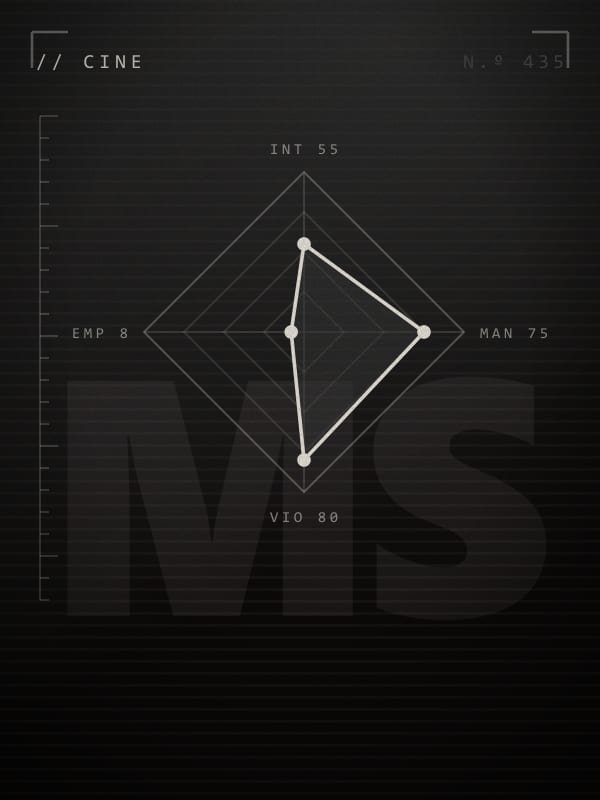
Enmu, Lower Rank One of the demon army in Demon Slayer, is neither the strongest nor the cleverest of the saga's villains. His power is more unsettling than spectacular: he manipulates dreams. He lulls his victims to sleep and slips into their unconscious to destroy them from within, savoring their despair with perverse delight while they believe themselves safe. His masterstroke is a night train full of sleeping passengers: hundreds of defenseless people, unconscious, surrendered to rest. For routine activity theory, Enmu is not merely a sadist; he is a walking manual of how crime materializes. Because he has understood, better than anyone, that you need neither a powerful target nor a brilliant plan: it is enough to find someone defenseless at the moment when no one is watching them. And there is no more defenseless moment than sleep.
// The theoryThe three-ingredient recipe
In 1979, criminologists Lawrence Cohen and Marcus Felson gave the discipline a shrewd turn. Instead of asking why someone decides to commit a crime —taking for granted that there will always be people willing to— they asked when and where crime becomes possible. Their answer is routine activity theory: crime occurs when three elements coincide in the same place and moment —a motivated offender, a suitable target (valuable, accessible, poorly protected) and the absence of a capable guardian—. It is the so-called crime triangle: remove a single vertex and the crime does not happen. What is revealing is that this guardian is almost never the police; it is a neighbor, a streetlight, a camera, a dog… or, in the case of a person alone, their own conscious vigilance. Enmu attacks precisely that last guardian. His gift creates neither the motivation nor the target —those were already there—: his specialty is eliminating the watchman. When you sleep, the guardian you carry within —attention, reflex, the ability to flee or call for help— shuts off. Enmu doesn't need to be stronger than his victims; he only needs to wait for them to fall asleep.
Sleep switches off the guardian
Cohen and Felson's great insight is that crime is a matter of convergence: a predator is not enough, the three pieces must come together. Enmu demonstrates it with almost didactic clarity. A waking passenger is a protected target —they can see the danger coming, scream, resist, alert a hunter—. That same passenger asleep is a perfect target: valuable (a life to devour), accessible (motionless) and, above all, without a guardian. Sleep changes neither the offender nor the victim; it changes the third vertex of the triangle, the only one that was missing. That is why Enmu pours all his power into putting people to sleep before touching them: he knows the battle is won by disabling the watchman, not by defeating him. The night train multiplies the effect —an enclosed space, at night, with hundreds of people who routinely fall asleep—. It is theory turned into setting: a place and a moment designed so that the three ingredients coincide effortlessly.
Get the map of theories for free
Subscribe to the criminal archive —one case a week, no spam— and I'll send you The map of theories: the great currents of criminology on a single sheet.
// The subjectThe predator who manufactures defenselessness
What sets Enmu apart from a crude predator is that he does not passively wait for the opportunity: he manufactures it. Most offenders in routine activity theory take advantage of an absence of guardian that already existed —the empty neighborhood, the unoccupied house, the dark alley—. Enmu goes one step further: he induces the state of defenselessness with his dream manipulation. It is the difference between the thief who robs an empty house and the one who first makes sure the family leaves. And to that calculating coldness he adds a deeply disturbing trait: enjoyment. Enmu does not kill only to feed or to serve his master; he revels in his victims' despair, in the instant the pleasant dream turns into a nightmare and they realize they are lost. His servility toward Muzan completes the portrait: he is an opportunistic predator downward —toward the weak and sleeping— and a devoted subject upward, toward the power that created him. That combination —calculation, cruelty and submission— makes him something more than a monster: an agent who chooses, again and again, the exact moment when his victims cannot defend themselves.
Enmu
// The crackOpportunity explains the when, not the cruelty
Here it is worth being honest about the limits of the theory. Routine activities explain when and where Enmu's crime materializes with remarkable precision —sleep, night, the train, the absence of a guardian—, but they do not explain why he enjoys doing it. Cohen and Felson take the offender's motivation for granted: they are interested in the geometry of opportunity, not the offender's heart. And there a huge gap remains. The theory tells us that Enmu attacks the sleeping because they are defenseless; it tells us nothing about his sadism, about the specific pleasure he draws from others' suffering. Opportunity describes the mechanism, not the evil. Reducing Enmu to «an opportunist who took advantage of an easy target» would be stopping halfway: there was choice, there was pleasure, there was deliberate cruelty.
And there is a second crack, more slippery, that the theory itself drags along: the risk of blaming the victim. If we insist too much on the «suitable target», the absurd idea could slip in that Enmu's victims were partly to blame for… falling asleep. It is dangerous ground, and it is worth marking clearly: sleeping is not recklessness, it is a basic human need. The target does not manufacture the predator. Explaining the crime by pointing to the absence of a guardian does not shift responsibility onto whoever was attacked; it leaves it, whole, with whoever chose to attack. To explain is not to excuse. Understanding that Enmu sought the instant of maximum defenselessness does not absolve him: it describes him as what he is —an agent who chose, with full intent, to prey on those who could not defend themselves—.
Restore the guardian before night falls
Enmu matters because he teaches criminology's most practical lesson: crime is prevented by taking away the opportunity. If crime needs the absence of a guardian, the defense consists of restoring it. In the fiction, the hunters defeat Enmu not by being crueler than him, but by regaining control over sleep —waking up, watching over one another, refusing to be left alone and unconscious before the predator—. It is exactly what situational prevention proposes: not to wait to change the offender's heart, but to close the window through which he enters. The lesson transfers effortlessly to real life: crime rarely falls at random, it chooses the moment of least vigilance —the empty house, the deserted street, the weak password, the isolated victim—. Protecting yourself is not living in fear nor giving up rest; it is understanding that much of security consists of not leaving the three vertices of the triangle alone and together. Where there is a guardian —human, technological or communal—, the predator who waits for you to drop your guard is left without his moment.
Three key takeaways
- Enmu embodies routine activity theory (Cohen and Felson, 1979): crime arises when a motivated offender, a suitable target and the absence of a guardian coincide. His power consists of eliminating the third vertex —the watchman— by putting his victims to sleep.
- Sleep is perfect defenselessness: it switches off the inner guardian (consciousness, reflex, the ability to flee). The night train brings the three ingredients together at once, and that is why it is his ideal setting.
- Opportunity explains the when and the where, not the cruelty nor the why. And the target does not manufacture the predator: sleeping is not a fault. To explain is not to excuse; Enmu chose to prey on those who could not defend themselves.
Sources · further reading
- Cohen, L. E. & Felson, M. (1979). «Social Change and Crime Rate Trends: A Routine Activity Approach». American Sociological Review, 44(4).
- Felson, M. (1994). Crime and Everyday Life. Pine Forge Press.
- Clarke, R. V. & Felson, M. (eds.) (1993). Routine Activity and Rational Choice. Transaction Publishers.
- Eck, J. E. & Weisburd, D. (1995). Crime and Place. Criminal Justice Press.
Case-file questionsFrequently asked questions
¿Quién es Enmu?
Enmu («Luna Inferior Uno») es un villano de Demon Slayer, analizado en KRIMINIS con la lente de la criminología. He doesn't kill while you fight: he waits for you to sleep.
¿Por qué Enmu (Luna Inferior Uno) se convierte en villano?
Enmu, Lower Rank One in Demon Slayer, and routine activity theory: the predator doesn't look for a motive, it waits for the instant the guardian disappears. And that instant is sleep.
¿Qué teoría criminológica explica a Enmu?
El caso de Enmu se analiza desde la Actividades rutinarias. Routine activity theory (Cohen and Felson, 1979) holds that crime occurs when three elements converge in the same place and moment: a motivated offender, a suitable target and the absence of a capable guardian. Enmu, Lower Rank One in Demon Slayer, is the embodiment of that calculus: he manipulates dreams to attack his victims while they sleep —defenseless, unconscious, with no one keeping watch—. The night train is his ideal setting because it brings the three vertices together at once. His case illuminates why sleep turns us into the perfect target: it is the moment when the inner guardian, consciousness, goes completely dark.