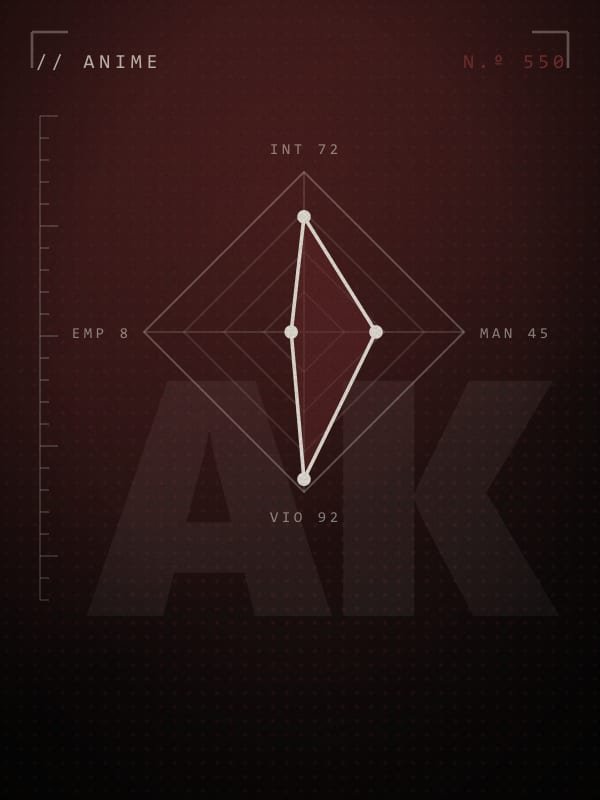
In One Piece, the world learned to fear pirates with their hats and black flags. Akainu —whose real name is Sakazuki— carries neither: he wears the uniform of the Marines, holds the rank of admiral and speaks in the name of the World Government. And yet, for many viewers, he is the most terrifying character in the saga —even more than the emperors he fights—. The reason is uncomfortable: Akainu does not destroy from piracy or chaos, but from order. His doctrine is called "Absolute Justice," and in its name he has sunk refugee ships, executed those who surrendered and sacrificed his own. For right realism, and read through the lens of the authoritarian personality, his case file raises a thorny question: what happens when faith in punishment and discipline —order as the supreme value— becomes itself the source of the crime?
// The theoryThe iron fist and faith in order
Right realism crystallized in the United States of the 1970s and 80s, above all with James Q. Wilson and his influential Thinking About Crime (1975). Its thesis is as simple as it is popular: let us stop looking for the "root causes" of crime in poverty or society —that, they say, is an excuse that protects no one today— and focus on what works: deter, watch, incapacitate and maintain order. The moral premise is individual responsibility: whoever breaks the law chooses to do so, and must be punished firmly. It is the criminology of common sense, with real virtues —it takes the victim seriously— and a structural danger that the school itself recognizes: when order becomes the only good, it begins to devour all the others, including the rights that made order worth having. To sharpen the psychological portrait of the subject who embraces that drift, it helps to add a classic idea: the authoritarian personality that Theodor W. Adorno and his colleagues described in 1950 —mental rigidity, blind submission to hierarchy, black-and-white thinking and hostile aggression toward anything perceived as "deviant"—. Akainu is, almost by the book, the point where both things meet: the ideology of the iron fist embodied in a character incapable of doubt.
When order becomes the only good
The most powerful intuition of right realism —and its trap— is that order matters in itself. Akainu takes that idea to its most brutal conclusion: for him there is no minor offense and no nuance, because any crack in discipline "invites" a greater evil. That logic fits what Adorno called dichotomous thinking: the world divides into friends and enemies, into the obedient and the deviant, with no middle ground. An archipelago of scholars studying forbidden history are not civilians: they are a threat to be eradicated. A pirate who has surrendered is not a prisoner: he is a pending execution. An ally who hesitates is not a comrade: he is an obstacle. When punishment becomes the supreme value, proportion vanishes and cruelty disguises itself as efficiency. Right realism warns of this with its own fictional heroes, judges and police who cross the line; Akainu is that warning without the comfort of a script that always proves him right: the iron fist that, rather than let a single culprit escape, is willing to burn a hundred innocents.
Get the map of theories for free
Subscribe to the criminal archive —one case a week, no spam— and I'll send you The map of theories: the great currents of criminology on a single sheet.
// The subjectThe admiral who sinks the innocent
The biography of Sakazuki is an accumulation of decisions that the law signed off and conscience should reject. In the episode of Ohara —the island of the archaeologists— he took part in the extermination operation that erased an entire population of scholars, and faced with the possibility that one might flee on an evacuation ship packed with civilians, he chose to sink it: better hundreds of dead innocents than a single "danger" on the loose. Years later, in the great war at Marineford, he finished off an already defeated enemy and pursued those who were retreating, without yielding an inch to mercy. His contempt for life makes no distinction of side: he even struck a subordinate who let a child escape, because for him compassion is a form of betrayal of duty. This is where the authoritarian personality illuminates the case more than any "villain" label: Akainu does not delight in suffering like a sadist: he obeys. He submits to a hierarchy —the World Government, "Absolute Justice"— that spares him the weight of deciding for himself what is just, and unleashes on the "deviant" an aggression that feels authorized, even obligatory. He does not believe he is the bad guy. He believes he is the only one hard enough to do what is necessary. And there lies the nuance that makes him unsettling: he is not an outlaw who breaks the law, he is the legitimate authority that carries it to atrocity with all the paperwork in order.
Akainu
// The crackThe law does not legitimize atrocity
The crack with Akainu is twofold, and both edges must be held at once. The first is the temptation to psychologize him until he dissolves: turning his rigidity, his zeal, his obedience into an alibi —"he just has an authoritarian personality," "the system made him this way"— that ends up erasing his responsibility. Neither right realism nor Adorno says that. Describing the character and the ideology that produce a Sakazuki serves to point more clearly at his guilt, not to dilute it: every ship he sinks and every surrendered man he finishes off is a choice of his, made by someone who could have doubted and chose not to. To explain is not to exonerate. The uniform does not wash away the crime, and the word "justice" engraved on the back does not make just what the back that wears it does.
The second edge is the opposite: to stop at "Akainu is a unique fanatic" and fail to see that his power was only possible because an entire structure —a Government, a doctrine, a chain of command— authorized him, promoted him and obeyed him. Reducing him to an individual anomaly reassures us, but it blinds us to what matters: that institutional punitive zeal is rarely the work of an isolated monster. It is built beforehand, and slowly, every time a society accepts that security justifies any means, that discipline stands above limits and that there are expendable lives so long as order is kept. The memory that matters here is not the admiral's, but that of those his "Absolute Justice" treated as fuel: the scholars of Ohara, the civilians of the sunken ship, all those whom a power convinced it was right decided could die so that it would not have to doubt.
The uniform does not make punishment just
Akainu matters because he dismantles a comfort: the belief that danger always comes from the one who breaks the law and never from the one who applies it. Right realism is right that order is a good and that the victim deserves protection today; but its own theory warns that, when order becomes the only value, the remedy begins to resemble the problem. The lesson is not to wait for the admiral who sinks refugee ships, but to recognize punitive zeal while it still disguises itself as reasonable firmness: in the one who admits no nuance, in the one who treats doubt as weakness, in the one who divides the world into the obedient and enemies. A decent society is measured not only by how it punishes its pirates, but by whether it knew how to set limits on its admirals —by whether it remembered, in time, that the most dangerous authority is not the one that despises justice, but the one that is certain it embodies it—.
Three key takeaways
- Akainu (Sakazuki) embodies right realism (Wilson) taken to the extreme: the iron fist and order as the supreme value, to the point where legitimate authority itself —"Absolute Justice"— becomes the source of the harm it claimed to fight.
- Read through Adorno's authoritarian personality, his profile is sharp: rigidity, submission to hierarchy, black-and-white thinking and aggression toward the "deviant." He does not delight in evil: he obeys, and that is why he sinks the innocent without feeling like the villain.
- To explain is not to exonerate. Describing the character and the system that produce an Akainu points to his responsibility with more precision, not less, and forces us to see the structure that authorized him. The uniform does not legitimize atrocity; the memory is for his victims.
Sources · further reading
- Wilson, J. Q. (1975). Thinking About Crime. Basic Books.
- Wilson, J. Q. & Kelling, G. L. (1982). «Broken Windows». The Atlantic Monthly.
- Adorno, T. W., Frenkel-Brunswik, E., Levinson, D. J. & Sanford, R. N. (1950). The Authoritarian Personality. Harper & Row.
- Young, J. (1999). The Exclusive Society. Sage.
Case-file questionsFrequently asked questions
¿Quién es Akainu?
Akainu («Sakazuki») es un villano de One Piece, analizado en KRIMINIS con la lente de la criminología. He sank a ship full of civilian refugees to make sure no fugitive got away.
¿Por qué Akainu (Sakazuki) se convierte en villano?
Akainu (Sakazuki) and right realism: how "Absolute Justice" and a zeal for order turn legitimate authority into the greatest threat. The iron fist that sinks the innocent rather than let a single culprit escape.
¿Qué teoría criminológica explica a Akainu?
El caso de Akainu se analiza desde la Realismo de Derecha. Right realism (James Q. Wilson) is the criminology of the iron fist: it sets aside social causes, demands discipline and puts order above almost everything. Admiral Akainu —Sakazuki— of One Piece takes that logic to the extreme with his doctrine of "Absolute Justice": he hunts, punishes and exterminates without hesitation, even civilians, children and allies, convinced that the end protects the world. His case file, read through Adorno's authoritarian personality as a lens, shows how institutional punitive zeal —when order becomes the only good— produces the very harm it claimed to prevent.